Faceoffs in Hockey: What You Must Know
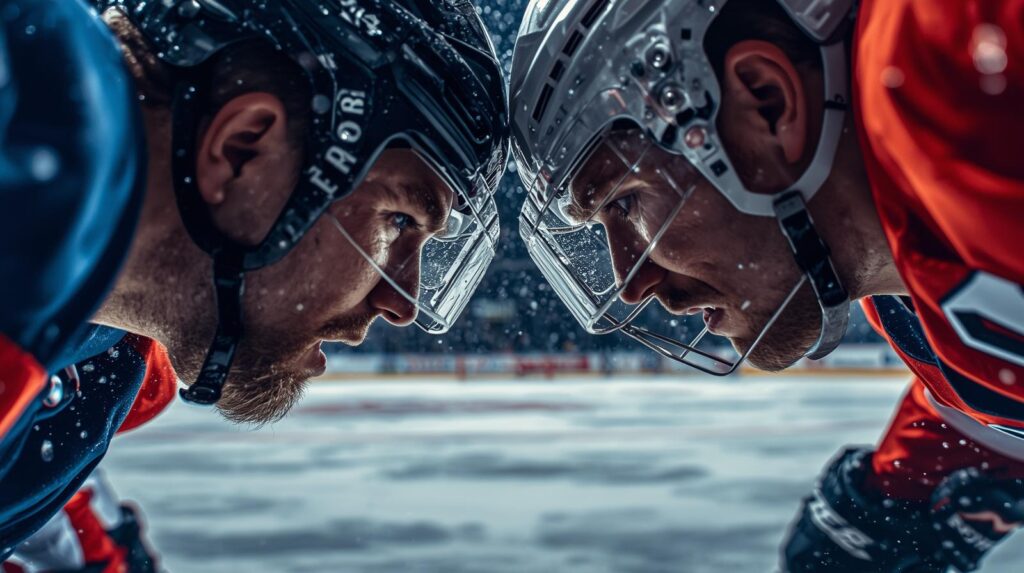
Table of Contents
- Why faceoffs matter in modern hockey
- What is a faceoff in hockey and when does it happen?
- Faceoff dots and locations: zones and how the spot is chosen
- Faceoff rules and procedure: what officials are enforcing
- Faceoff violations and penalties
- Faceoff strategy: turning one touch into possession
- Faceoff technique and timing: what’s really happening
- Stick and equipment factors in faceoffs: what helps, what’s mostly noise
- NHL vs IIHF faceoff rules (and other rulebooks): why details don’t always transfer
- Faceoff FAQ
Why faceoffs matter in modern hockey
A faceoff is one of the few moments in hockey that begins from a controlled reset: a marked spot on the ice, set positions, and a predictable first contest. That makes it unusually valuable. One clean win can turn a stoppage into immediate zone time, a quick exit under pressure, a first pass on the power play, or a safe way to manage the clock late in a period.
Faceoffs don’t decide games on their own, but they often decide who controls the next few seconds. At pro pace, that window is enough to create a chance—or prevent one.
What is a faceoff in hockey and when does it happen?
A faceoff restarts play after a stoppage, with an official dropping the puck between two opposing centers. In many North American competitions, the linesperson handles most faceoffs, while responsibilities can vary by league.
Common stoppages that lead to faceoffs include the start of a period, goals, offside, icing, a puck out of play, and a goalie freeze. Whistles tied to high-stick situations or unsafe play also produce faceoffs, but the exact trigger isn’t identical across rulebooks. Some codes tie the whistle to specific contact above the allowed height; others focus on whether the action materially affects play or creates danger.
Faceoff dots and locations: zones and how the spot is chosen
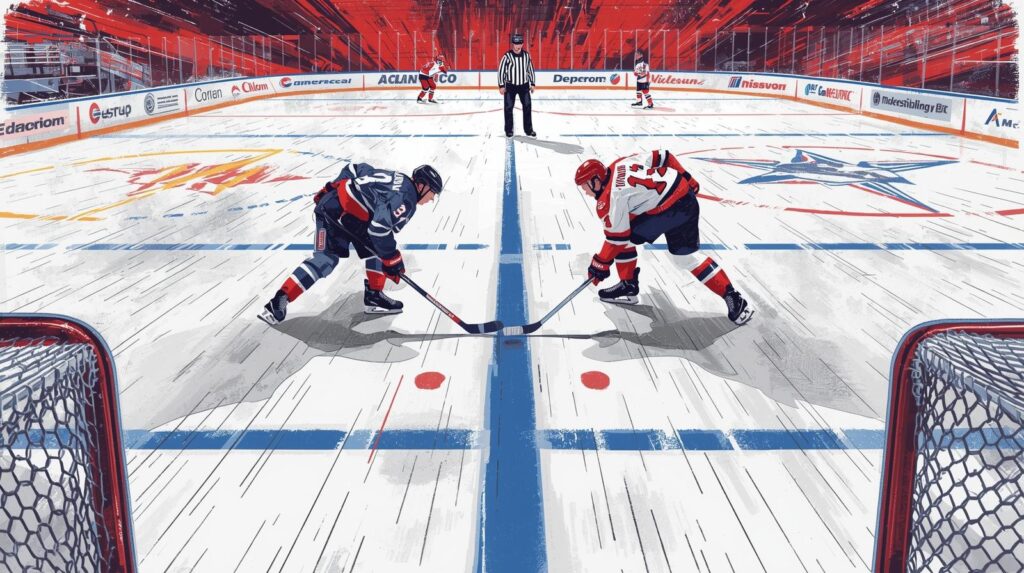
Most standard rink markings use nine faceoff spots: one at center ice, four in the neutral zone, and two in each end zone. The next faceoff location depends on why play stopped and on the league’s placement rules.
The broad pattern looks familiar across most competitions. After a goal, play returns to center ice. After icing (if it isn’t waved off), the faceoff typically comes back to the offending team’s defensive zone. After offside, the faceoff usually moves to the neutral zone, with placement details depending on the offside standard and enforcement.
Faceoff rules and procedure: what officials are enforcing
The procedure isn’t ceremony. Tiny advantages before the puck is live can decide possession, so officials focus on positioning, timing, and early contact.
Player positioning at a faceoff
Centers take the draw, while wingers and defensemen line up outside the circle at the marked locations. Across rule sets, the idea is consistent: players can’t step in early, crowd the circle, or gain position before the puck is in play. The exact distance, the specific markings used, and how tightly it’s enforced can vary by league.
Stick and skate placement on the faceoff dot
Some leagues describe stick placement very precisely, including which part of the faceoff spot the blade must contact and how skates must align with restraining lines or nearby markings. Others keep the language more general and rely on officiating standards to keep the setup fair.
In practice, officials are looking for the same thing: both centers must be set in a legal posture, with sticks placed where the rulebook and the official indicate, and without movement that effectively “starts” the play early.
Who puts the stick down first on a faceoff
This is one of the most rulebook-specific details in hockey. Some North American codes assign “stick first” to a specific side in most situations and handle center-ice draws as a special case. NHL and IIHF language and enforcement can differ, so it’s not a universal rule that transfers cleanly across competitions.
Faceoff timing, puck drop tempo, and line changes
Faceoff procedure also helps prevent time-wasting. Many leagues limit or control line changes after certain stoppages—icing is the classic example—then push teams to set quickly. Some rulebooks codify timing tools and escalation steps; others leave more to game management, warnings, and consistent enforcement.
Faceoff violations and penalties
Most faceoff violations fall into two buckets: trying to gain an advantage before the puck is live, or failing to respect the required positions around the circle. The first consequence often isn’t a penalty—it’s losing the original center for that draw, which can break a planned play.
Why a center gets removed from the faceoff dot
Typical triggers include refusing to follow the official’s instructions, taking too long to get set, early movement toward the puck, premature stick action, or initiating contact before the puck is dropped.
At higher levels, the bar can look strict because the margins are real: if a player is consistently “stealing” a fraction of a second, the draw stops being a fair restart.
When a teammate’s violation removes the center
A center can be removed because of a teammate’s encroachment or early movement. That’s not random; it’s a control mechanism. If only the winger were punished, teams could “cheat” the circle with early winger positioning while keeping their best center on the dot. By tying consequences to the draw-taker, rulebooks keep the entire unit accountable.
Repeated faceoff violations and delay-of-game escalation
Escalation is rulebook-dependent. Some competitions use warnings first, then move to bench minors or delay-of-game penalties; others penalize repeated procedural violations more quickly, including situations where multiple resets occur on the same faceoff sequence. The consistent logic is that officials need a tool to stop endless resets while preserving a fair restart.
Early contact off the draw and interference standards
Contact before the draw is completed is often judged through an interference lens: if a player prevents an opponent from participating fairly in the faceoff play, it can become a penalty. The line between “battle for the puck right after the drop” and “illegal early pick” is handled differently by rule set and by officiating standards, which is why marginal plays are managed loosely in one competition and called tightly in another.
Faceoff strategy: turning one touch into possession
Faceoff tactics usually revolve around two decisions: where the puck is supposed to go and who becomes the first support player if it doesn’t go cleanly.
Common faceoff win plays and outcomes
A classic option is pulling the puck back to a defenseman—especially in the offensive zone—so the team can shoot quickly, move the puck laterally at the blue line, or run a pre-set sequence. Another frequent pattern is directing the puck into the boards for a winger to seal and retrieve.
Not every “win” is clean. In many draws, the center’s job is to tie up the opponent’s stick and body position just long enough to create a loose puck that the winger can pick up. At pro level, the value is repeatability and readiness for the bounce, not the aesthetics of the motion.
Wingers and defensemen on faceoffs
Wingers often decide the outcome in the first step: angle into the lane, body position on the opponent, and first contact with the loose puck. Defensemen manage the blue line, provide the first outlet, and protect against an immediate counter if the draw is lost cleanly.
Faceoff strategy by zone: offensive, defensive, and neutral zone draws
In the defensive zone, priorities usually skew toward risk control: preventing an immediate slot chance, steering the puck to safer areas, and keeping a controlled exit option available. In the offensive zone, speed matters more: a quick puck to the point for a shot, a lateral move along the blue line, or a short pass that changes the shooting angle before coverage settles. In the neutral zone, faceoffs often connect directly to pace management—either retaining control to enter with possession or pushing the puck deep and winning the next battle.
Faceoff technique and timing: what’s really happening
A faceoff is a short lever fight: wrist action, stick-on-stick contact, body balance, and the ability to protect the intended puck path while teammates take their routes. It’s often described as “reaction to the drop,” but the bigger picture is coordinated. The center’s motion only becomes a true advantage if the rest of the unit is already moving into the right lanes without crossing the procedural line.
You occasionally see a puck played almost as it’s falling. Whether that’s legal or treated as a violation depends on when the puck is considered “in play” under that competition’s rules, and on whether the official reads the action as playing before the drop rather than immediately after it.
Stick and equipment factors in faceoffs: what helps, what’s mostly noise
Gear doesn’t replace structure, but it can affect repeatability. On draws, players care about how consistently the blade tracks the ice and how predictable the stick feels in stick-to-stick contact.
Blade curve and lie influence which part of the blade naturally engages the puck in a player’s stance. Flex and durability matter less as “extra power” and more as consistency—if the stick behaves differently under the same pressure, timing-based wins become less reliable. Tape, grip, and length are personal adjustments that can improve feel, but they rarely outweigh team setup and procedural enforcement.
NHL vs IIHF faceoff rules (and other rulebooks): why details don’t always transfer
The faceoff concept is broadly consistent: a controlled restart, restrictions on early entry into the circle, positioning requirements, and limits on early contact. The details fans argue about—stick-first sequence, setup timing, when repeated violations become penalties, and who serves a bench minor—are precisely the parts most likely to change between NHL-style enforcement, IIHF standards, and domestic rulebooks such as USA Hockey or Hockey Canada.
A useful way to think about any faceoff explanation is in two layers. One is universal logic: officials prevent false starts and protect a fair restart; teams build quick possession plans around a single touch. The other is local rule language: exact positioning standards, timing tools, escalation steps, and how strictly edge cases are managed.
Faceoff FAQ
Why can a player be removed from the dot before the puck is dropped?
Because the official sees a procedural violation—positioning, early movement, teammate encroachment, or early contact. Swapping the center is a fast reset that restores fairness without turning one stoppage into repeated re-drops.
Who must put the stick down first?
It depends on the competition’s rulebook and enforcement standard. Some codes specify an attacking/defending order; others handle it differently, including special handling for center-ice draws.
How many faceoff dots are on a standard rink?
Nine on the standard marking layout, though the rulebook determines exactly which dot is used after specific stoppages.
What counts as a “won” faceoff in stats?
Typically, the team that gains first controlled possession after the drop. Edge cases depend on the tracking system used.
Can players hit immediately off the draw?
Contact around the draw is judged through interference/roughing standards and through the “draw completion” concept in that rule set. Early contact that prevents an opponent from participating in the play can be penalized; once the puck is clearly live, enforcement shifts toward normal puck-battle rules.