Fighting in Hockey: What’s Allowed and What Isn’t
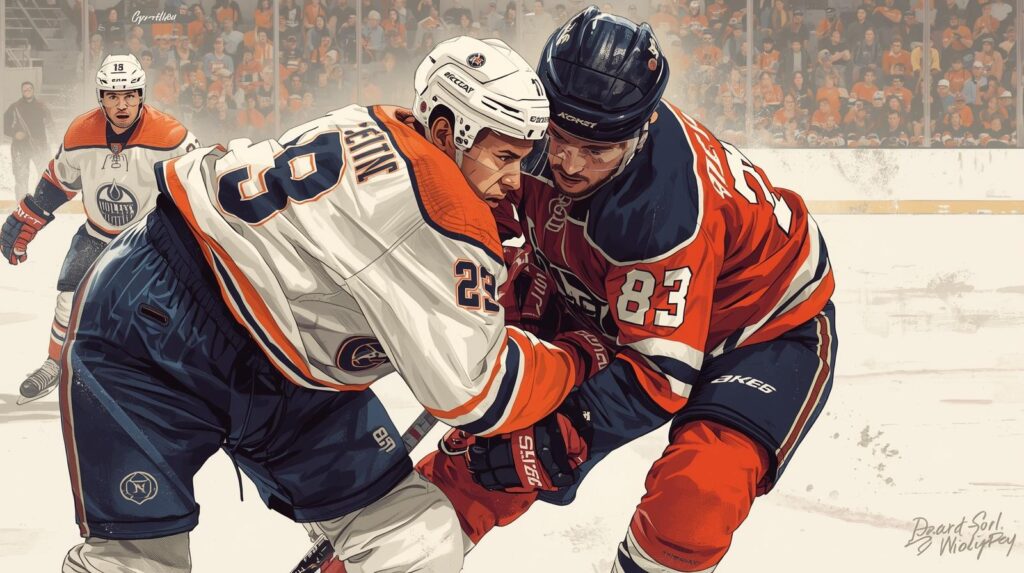
Fights in hockey are rarely called “allowed” in any legal sense: in almost any league, fighting is a violation. What differs is how exactly it is built into the disciplinary system. In some places an incident more often ends with a standard major for both participants, while elsewhere it almost immediately turns into a game ejection and a separate disciplinary case.
In the North American tradition, especially in the NHL, fighting has long been treated as a “managed risk”: officials issue a clear, predictable penalty, the game continues, and the most dangerous details are handled through separate sanctions. In IIHF international tournaments and in many European leagues, the approach is usually stricter: fighting more often leads to a game ejection and further review. In the USA Hockey system, there are generally more mechanisms that make fighting costly for both the player and the team, but the specific consequences depend on the level of competition and the applicable rule set.
Table of Contents
- Fighting Rules by League: NHL, IIHF, and USA Hockey
- What Counts as Fighting in Hockey?
- Roles and Responsibility in Hockey Fights
- When Fighting Penalties Get Harsher: Common Triggers
- Repeat Offenses and Suspensions: Progressive Discipline for Fighting
- USA Hockey Junior Playing Rules 2025–29: When Context Changes the Outcome
- Hockey Fighting Fines: Why Amounts Are Rarely Universal
- How to Evaluate a Fight Under Different Hockey Rules
Fighting Rules by League: NHL, IIHF, and USA Hockey
NHL Fighting Rules: Five-Minute Major and Additional Penalties
In the NHL, a fight is typically ruled as fighting and punished with a major (most often 5 minutes) for the participants. Because majors are often assessed symmetrically, the game doesn’t always shift into a power play/penalty kill situation—hence the perception of tolerance.
At the same time, it’s usually the additional notations in the official report that determine whether the incident stays a “five-minute major” or becomes a disciplinary problem. These boosters include situations such as the instigator, aggressor, third man in, leaving the bench, as well as incidents that look like punches to an opponent who is unprepared or clearly unwilling to fight. In more serious cases, a game misconduct and more significant disciplinary consequences are possible, including separate league decisions (supplementary discipline), especially if there is an injury, clear intent, or a repeated pattern.
IIHF Fighting Rules: More Often a Game Misconduct, but Not Always a Match Penalty
Under IIHF international rules, fighting is generally treated more harshly than in the NHL and often results in a game misconduct. At the same time, it’s more accurate to avoid the phrasing “it’s always a match penalty”: the IIHF uses its own categories of disciplinary penalties, and the final entry in the game report depends on the composition of the incident—who initiated it, whether there was escalation, third-party involvement, dangerous actions, and health consequences.
From a spectator’s perspective, the result is usually the same—the player is no longer on the ice. From a disciplinary perspective, the difference matters: different grounds can mean different follow-up sanctions.
USA Hockey Fighting Rules: Strict Discipline and High-Risk Triggers
In USA Hockey, fighting often leads not only to a major penalty but also to disciplinary sanctions at the misconduct/game misconduct level. At certain levels and in specific editions of the rules, actions involving the helmet/facemask, third-party involvement, and repeat offenses can quickly move an incident into the most serious category.
What Counts as Fighting in Hockey?
Definitions of fighting across different systems are similar in meaning, but the threshold can differ. In some places the emphasis is on an exchange of punches; in others, on the very attempt to start a fight.
In USA Hockey rules (Official Rules & Casebook 2025–2029, Rule 615), there is a strict formulation: a punch or an attempt to punch directed at an opponent is treated as fighting regardless of whether contact was made. This noticeably raises the sensitivity of how incidents are classified: an episode doesn’t have to look like a “classic fight” to fall under Rule 615.
In other leagues, a similar action may sometimes be ruled differently—for example, as roughing or unsportsmanlike conduct—depending on context and the specific definition of fighting in that rulebook.
A separate nuance is the difference between fighting and post-whistle scrums. A short tussle, shoves, holding, and an exchange of little jabs can fall under other rules. Fighting more often triggers harsher discipline, and that’s exactly why leagues try to describe it as precisely as possible.
Roles and Responsibility in Hockey Fights
Discipline around fights is almost always built not only on the fact of fighting, but also on the distribution of roles.
Instigator is usually used for the player who starts the conflict. In USA Hockey junior rulebooks (Junior Playing Rules 2025–29), this isn’t “one gesture” but a set of indicators: who dropped the gloves first, who threw the first punch, whether there was a threatening manner, verbal provocation, or retaliation for a previous incident. This kind of description gives the official room to separate an emotional outburst from a deliberate attempt to start a fight.
Aggressor is more about escalation and injury risk: a clear advantage and continued punching, or dangerous actions such as forcefully throwing/taking an opponent down to the ice. In some systems, aggressor can lead to a game misconduct or a match penalty, especially if the referee sees reckless endangerment.
Third man in and the “first intervenor” are a separate disciplinary zone. In many rulebooks, third-party involvement is treated as one of the most undesirable factors: it makes the incident harder to control and increases the chance of a line brawl.
When Fighting Penalties Get Harsher: Common Triggers
Instigator and Retaliation
Even when fighting looks symmetrical, rules often try to separate responsibility. In USA Hockey Rule 615 (2025–2029 edition), the instigator receives an additional penalty: the text states directly that a minor for starting/instigating a fight is added to fighting.
The same section also relies on the logic of retaliation: a player who, after being struck, continues the altercation with retaliatory actions can receive a heavier combination of sanctions—up to a major plus a game misconduct, at the referee’s discretion. Conversely, Rule 615 explicitly states that a player who does not retaliate after being struck should not receive a fighting penalty under this rule. This affects the report more than it might seem: “didn’t continue” and “fought” are different disciplinary events.
Joining the Altercation and Dropping the Gloves
Many rulebooks are designed to keep a conflict from spreading. In USA Hockey Rule 615 there is a separate sanction for a player who is not involved in the original altercation but drops their stick and/or removes their gloves during the incident: a minor is assessed. If such a player, in the referee’s view, becomes the instigator of a subsequent altercation, a game misconduct is added.
This rule illustrates the philosophy of discipline well: it punishes not “emotion on the bench,” but actions that take the next step toward escalation.
Intervening in an Ongoing Fight
USA Hockey Rule 615 provides an extremely harsh response to intervention: the first player or goalkeeper who intervenes in an altercation already in progress receives a game misconduct, and that penalty is assessed in addition to any other penalties in the incident.
In USA Hockey junior rules, this idea is reinforced by separate automatic sanctions for secondary fights and other scenarios where one conflict hooks onto another.
Officials’ Control and Bench-Clearing Prevention
Some rules are aimed not at punishing the fight itself, but at maintaining control of the situation. USA Hockey Rule 615 includes a minor for refusing to go immediately and directly to one’s bench (and for a goalkeeper—toward their goal crease area) when the referee requires it during an altercation. The purpose is straightforward: fewer people around means a lower chance the incident turns into a bench-clearing situation.
Helmet and Facemask Rules: The Strictest Zone in USA Hockey
Actions involving the helmet/facemask in amateur and youth systems are often treated as the line beyond which injury risk becomes too high. In USA Hockey Official Rules & Casebook 2025–2029 Rule 615(c), this is written with maximum specificity and in terms of legal triggers:
— A match penalty is assessed to a player who deliberately removes their own helmet/facemask prior to an altercation.
— A match penalty is assessed to a player who deliberately removes an opponent’s helmet/facemask prior to or during an altercation.
— A game misconduct is assessed to a player whose actions during an altercation cause the removal of an opponent’s helmet and facemask; the text then specifies a two-game suspension for the team’s next games, in addition to any other mandatory suspensions from the incident.
— A game misconduct is assessed to a player who wears a helmet/facemask other than as designed, and as a result the equipment comes off during an altercation.
The key detail here isn’t “strictness for strictness’ sake,” but that the rule is separated by elements: “deliberately removes” and “causes the removal” are different grounds that the referee records based on actions and context.
Repeat Offenses and Suspensions: Progressive Discipline for Fighting
At some USA Hockey levels, discipline is structured like a ladder. Rule 615(f) (Official Rules & Casebook 2025–2029) states that a second fighting major in the season with the same team leads to a three-game suspension. A third results in a suspension pending a hearing under supplementary discipline procedures (Rule 410).
In terms of how it feels during a game, it may look the same: “another fight.” In a disciplinary system, it’s already a different severity because repeat behavior is treated as an independent risk factor.
USA Hockey Junior Playing Rules 2025–29: When Context Changes the Outcome
USA Hockey junior rules often describe fighting in more detail and in a more situational way than professional rulebooks. What matters there is not only roles and actions, but also the game moment and how exactly the conflict began.
In Junior Playing Rules 2025–29 (under the published logic), base sanctions differ by level: for Tier I and Tier II, a fight leads to a major plus a misconduct; for Tier III, to a major plus a game misconduct. This isn’t cosmetic: a game misconduct means the player is done for the night.
That document also separately highlights contexts where fighting almost automatically becomes a more serious violation. For example, a fighting major in the final five minutes of regulation time, as well as in overtime or a shootout, leads to a game misconduct and an automatic suspension for the team’s next two games. It also describes staged fights (including the example of a fight immediately after a faceoff), secondary fights, fights during line changes before the next faceoff, and incidents off the playing surface or before/after games and periods. The overall logic is simple: these scenarios most often trigger a chain reaction, so the rulebook puts in a “disciplinary emergency brake.”
Hockey Fighting Fines: Why Amounts Are Rarely Universal
Monetary fines in hockey are structured differently than penalty minutes. Minutes are part of the on-ice rules of the game, while fines usually live in the disciplinary system of a specific league, tournament, or organizer. That’s why in one context you can see clear amounts and caps, while in another you’ll see only references to possible fines and disciplinary sanctions without numbers.
In the NHL, fines are part of league discipline and collective agreements, and they often sit alongside suspensions and Department of Player Safety decisions. In junior and tournament documents, fines are often aimed not only at players but also at teams and applied to specific scenarios—for example, fights outside the rink or conflicts that occur outside of playing periods. In Junior Playing Rules 2025–29, you can directly find language about possible team fines with stated limits and per-player, per-incident add-ons, which underscores the point: this is an organizer’s discipline tool, not a universal “rule of hockey as a whole.”
In an article about rules & fines, it’s important to keep that distinction in focus: rules define the framework of what counts as a violation and how officials manage the game, while fines more often reflect how a league manages consequences after the game.
How to Evaluate a Fight Under Different Hockey Rules
A fight is almost never judged solely by the formula “two guys fought—both got the same.” In practice, the details decide it: who started, who continued, who intervened, what happened to the helmet/facemask, where exactly the incident occurred, and whether it turned into a secondary fight. Even when things look similar on the surface, different rulebooks can reach different disciplinary conclusions—and produce different consequences already at the game report level, not to mention league decisions after the game.