The Truth About High-Sticking, Slashing, Tripping, Boarding
A penalty in hockey almost always changes the balance of power on the ice: a player goes to the penalty box, and the team spends time shorthanded against the power play. It’s often a tempo shift, too—especially if the call happens during a set offensive-zone attack or late in a period. The details, though—how many minutes, whether the penalty ends after a goal, whether there will be supplemental discipline—depend on the league’s rulebook: NHL, IIHF, and national federations tend to follow similar logic, but they aren’t identical.
Table of Contents
- Hockey penalty types: minor, double minor, major, misconduct, game misconduct, match penalty
- Delayed penalty in hockey: why the referee has an arm up but there’s no whistle
- High-sticking penalty: when stick contact becomes dangerous
- Slashing penalty: where stick work ends and “chopping” begins
- Tripping penalty: when a trip breaks balance and costs position
- Boarding penalty: danger at the boards and the initiator’s responsibility
- How referees call high-sticking, slashing, tripping, and boarding
Hockey penalty types: minor, double minor, major, misconduct, game misconduct, match penalty
A minor is usually two minutes. In many rulebooks it ends when the team on the power play scores, but the principle is “one minor comes off.” If the shorthanded team has two minors running at the same time (the classic 5-on-3), a goal usually ends only one of them, and the other continues.
A double minor is four minutes, treated as two consecutive minors. A goal during the first half wipes out only the first two minutes, with two more still to serve.
A major is most often five minutes and is served in full regardless of goals. Leagues use it for plays they consider significantly more dangerous.
A misconduct (usually 10 minutes) is a personal penalty. By itself, a misconduct doesn’t create a manpower disadvantage: the team puts a substitute on the ice immediately. You only get the “down a skater” effect if a minor or major is also assessed for the foul itself—which is why a 2+10 combination shows up so often in practice.
A game misconduct means removal for the rest of the game. On the scoresheet it may appear as “discipline minutes,” but the on-ice impact is simple: the player is done for the night.
A match penalty, across different systems (North American and international), is tied to actions interpreted as an intentional attempt to injure—or conduct that’s as close to that level of danger as the rules describe. In practice it’s usually “ejection + a team penalty” served by a substitute player; most often it’s five minutes that do not end after goals. A match penalty is almost always followed by a separate disciplinary review, but the format depends on the league.
Delayed penalty in hockey: why the referee has an arm up but there’s no whistle
A delayed penalty is when an infraction has been identified, but play continues until the offending team gains control of the puck (possession/control). The team that was fouled can keep attacking and will often pull the goalie for an extra skater. The risk of an empty-net goal is usually limited by the fact that play will be stopped once the offending team controls the puck, but nothing here is completely “risk-free”: turnovers on changes, bad back passes, and deflections do happen.
High-sticking penalty: when stick contact becomes dangerous
High-sticking as a foul is contact with an opponent caused by a stick being carried too high. Most of the time it’s in the head, face, or upper-body area, but the point of the rule isn’t “height for height’s sake”—it’s dangerous contact.
High-sticking shows up regularly in tight battles: along the boards, in traffic in front of the net, on faceoffs, on quick turns, or during active hand work. At speed, a small motion can put the blade in the face area—and the play becomes penalty-worthy regardless of whether it looked intentional. In many leagues, protecting the head and face is a point of emphasis, so these contacts are judged more strictly than most low-stick tangles.
High-sticking penalty minutes: minor, double minor, major
The typical call is two minutes. A double minor (four minutes) in many leagues is tied to injury; blood is often used as a practical indicator, but it is not a universal automatic “trigger” in every rulebook. A referee can assess four minutes without blood if there’s visible damage.
If the contact looks extremely dangerous—gross carelessness, an obvious attempt to strike, serious consequences—the punishment can escalate to a major and stricter disciplinary outcomes. The exact “ladder” of sanctions depends on the league and its language.
High-sticking vs high stick (puck): what’s the difference?
In conversation, these get mixed up. High-sticking as a penalty is about stick contact on an opponent. A “high stick” in the puck context is about how high you’re allowed to play the puck with your stick, and when that leads to a stoppage or a disallowed goal. The general logic in the NHL and IIHF is similar, but the details of the criteria and how “immediate” action is interpreted can differ.
Follow-through high-sticking: can it still be a penalty?
A common flashpoint is contact that happens on the follow-through after a shot. In some interpretations, a referee may consider whether it was a natural continuation of the shooting motion, but that doesn’t guarantee there won’t be a penalty. If the contact is dangerous and lands in the head or face area, high-sticking remains a very real outcome—because risk and consequences are always central to the judgment.
Slashing penalty: where stick work ends and “chopping” begins
Slashing is a stick swing at an opponent or at an opponent’s stick that a referee deems excessive or dangerous. Hockey has constant stick-on-stick contact, so slashing isn’t about contact existing at all—it’s about the nature of the motion: a wind-up, a chopping action, the force of the blow, the point of contact.
On a broadcast these plays often look the same: a defender “hits the stick to knock the puck loose.” In real officiating, the nuances matter. In many leagues, sensitivity is especially high around strikes to the hands and gloves: even if a player aimed at the stick, contact on the hands plus a chopping motion is often treated harshly because the injury risk is high.
Slashing penalty minutes: what affects severity
Most often it’s two minutes. Harsher outcomes—major, ejection, supplemental discipline—show up when the play looks clearly dangerous or resembles an attempt to cause injury. In some places consequences carry more weight; elsewhere it’s the mechanics of the swing and the “quality” of the wind-up. This is exactly the kind of situation where the league’s rulebook and enforcement practice matter more than any everyday “universal” rule.
Tripping penalty: when a trip breaks balance and costs position
Tripping is an action that makes an opponent fall or clearly lose balance because of a trip with the stick, a foot, a hand, or a body part placed into the skating lane. In game flow, it most often looks like a player being late: they can’t get there with their feet, reach with the stick, and clip the skates.
Typical situations include a fast zone entry, a sudden change of direction, a short board battle where skates cross at minimal distance. Defensively, tripping often happens as an attempt to break up a chance that feels too dangerous. That doesn’t justify it, but it explains why trips often occur in the hottest moments of a shift.
Tripping and penalty shots: when a penalty shot is awarded
Usually tripping is a minor (two minutes). But if the foul takes away an obvious chance to score, some rule sets allow a penalty shot instead of the standard penalty. The criteria for “obvious” differ between the NHL, IIHF, and other leagues, as do the details of what counts as a completed scoring opportunity.
Some rules also provide for awarding a goal in specific situations—for example, when a foul is committed against a player controlling the puck who has a real ability to put it into an empty net. The wording and conditions here are especially tied to the specific rulebook.
Embellishment and tripping: why not every fall is a penalty
A player can catch an edge, lose an edge, collide body-to-body, and go down from momentum. There’s also the opposite extreme—embellishment, meaning exaggerating the contact. In the NHL and some North American rule sets, there are separate sanctions for that, but in practice it comes down to the referee’s read: was there contact, how much did it affect the skating lane, and did the player “sell” the play.
Boarding penalty: danger at the boards and the initiator’s responsibility
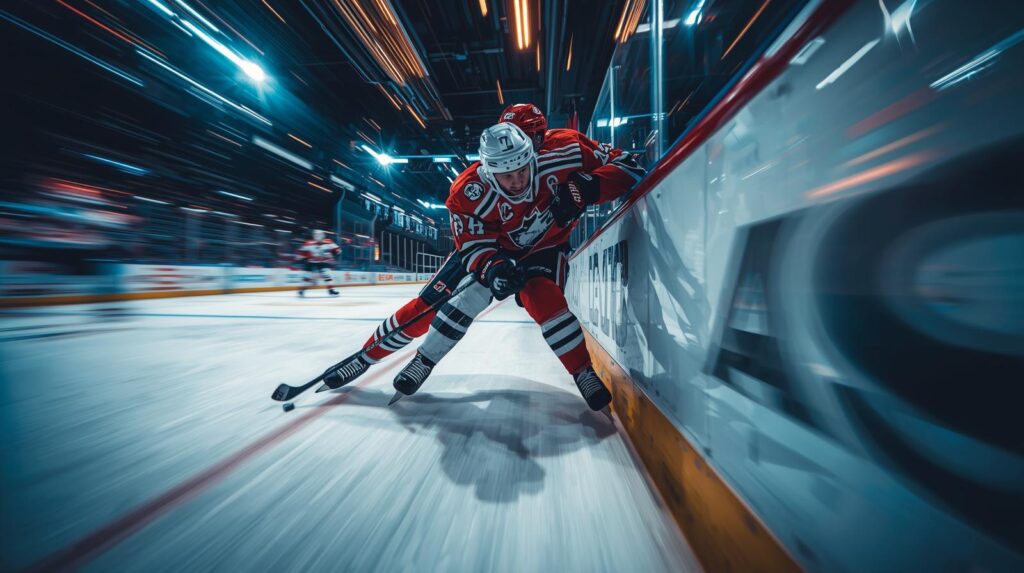
Boarding is when, because of a push or hit, an opponent is driven dangerously into the boards. The key is that boarding describes not a “type of body check,” but risk at the boards. What would look like routine contact in open ice can become dangerous near the wall: less space, less time to brace, higher injury risk on impact with the boards.
The boards amplify the risk of head, neck, and shoulder injuries, so in modern interpretations across leagues the overall principle is similar: the initiator of contact has to account for the opponent’s position and the likely outcome, especially if the opponent is vulnerable or unprepared for impact.
Boarding penalty minutes: minor, major, and match penalty
The tiers and language depend on the rulebook, but the logic usually revolves around degree of danger. Referees look at distance to the boards, the player’s position (including being turned with their back), the direction of the contact, whether there’s a push from behind, “acceleration through the hit,” and whether the action resembles a hockey play on the puck or looks more like punishment/intimidation.
In the North American system, including various USA Hockey levels, a basic minor is common, and for extremely dangerous play a major and disciplinary penalties up to removal for the rest of the game can apply. In some cases a match penalty is also possible, but the criteria depend on the league.
Boarding vs checking from behind vs charging: what’s the difference?
These infractions overlap. Checking from behind is about contact from the rear that removes an opponent’s ability to prepare. Charging is about excessive speed and the nature of the force; there’s usually no fixed number of steps in the rulebook despite the persistent myth. Boarding is about risk at the boards and positional vulnerability. One play can include elements of multiple fouls, and the classification depends on what best reflects the mechanics and risk under the specific rules.
Legal contact along the boards: what often isn’t boarding
A hard pin along the boards or a “rub out” is often considered legal if the contact is controlled and doesn’t turn into a dangerous “drive,” and if the opponent isn’t left in a defenseless position. Some interpretations spell this out, but it isn’t a universal across-the-board rule for every league—context decides a lot.
How referees call high-sticking, slashing, tripping, and boarding
High-sticking almost always comes down to dangerous stick contact in the upper body area. Slashing comes down to a chopping motion and risk to the hands, even if a player “aimed for the stick.” Tripping comes down to a trip that breaks balance and disrupts skating. Boarding comes down to vulnerability at the boards and the initiator’s responsibility for a predictably dangerous outcome.
Differences between leagues show up less in whether “this is a foul here but not there,” and more in where the practical severity threshold sits, which details are treated as decisive, and how actively a league in a given season emphasizes a particular risk area.