The Simple Truth About Delay of Game in Hockey
Delay of Game in hockey isn’t one specific foul, but a group of situations where a team gains an advantage through an unnatural pause: it disrupts the pace, makes it easier to break out under pressure, or prevents play from restarting quickly. Another important point: different organizations don’t hide identical sets of rules under the label Delay of Game. NHL, IIHF, and USA Hockey overlap a lot in logic, but the wording and the sanctions can differ in the details.
Table of Contents
- What is Delay of Game in hockey?
- What penalty do you get for Delay of Game?
- The most common Delay of Game situations in hockey
- Puck over glass: the puck goes directly out of play from the defensive zone
- Deliberately sending the puck out of play or delaying the restart after the whistle
- Deliberately “freezing” the puck along the boards or near the net
- A goalie deliberately causes a stoppage with no pressure
- Dislodging the net (net dislodged): from two minutes to harsher sanctions
- A goalie removing their mask/helmet to stop play
- The trapezoid rule and Delay of Game (where it exists)
- Coach’s challenge: an unsuccessful challenge as a bench minor (NHL example)
- How referees call Delay of Game: automatic vs judgment calls
- Common questions about Delay of Game
What is Delay of Game in hockey?
In practical terms, Delay of Game is about controlling tempo. In hockey, a stoppage is valuable in itself: it gives you a chance to change, reset your defensive structure, get special teams units out, and break the rhythm of a sustained offensive-zone attack. That’s why the rules try to cut off situations where you can “buy” a stoppage with an action that isn’t part of the natural development of the play.
That leads to a key feature: some Delay of Game variants work almost automatically (based on the action itself), while others require a referee’s judgment—was there pressure, was there a real chance to keep playing, did it look like a deliberate choice to force a stoppage.
What penalty do you get for Delay of Game?
Most often it’s a minor penalty (2 minutes). In some cases a bench minor is assessed—when the delay is tied to the bench, line changes, or procedural team decisions.
Separately, some rulebooks include stronger consequences—a penalty shot or an awarded goal—but that’s not a universal hockey standard; it’s a tool used by a specific league. Usually those measures show up where the delay directly ruins an obvious scoring chance or prevents an almost inevitable goal.
The most common Delay of Game situations in hockey
Puck over glass: the puck goes directly out of play from the defensive zone
The most talked-about version in North American hockey is when a player in the defensive zone shoots the puck so it goes directly out of play (with no touches on the way). The idea is simple: remove a defensive “life hack” that gives the defending team a free stoppage under pressure.
But in the details it doesn’t boil down to a casual “it went out, so it’s a penalty.” Different rule sets describe “directly” in different ways, treat stick or player deflections differently, and factor in how a particular arena is configured (glass/netting/unprotected gaps). The general logic is: if it’s a clean, direct send-out from the defensive zone that stops play for no external reason, a penalty often follows. If the puck changed trajectory because of a touch, the decision can be different.
Deliberately sending the puck out of play or delaying the restart after the whistle
There’s also a more “classic” Delay of Game: a player deliberately shoots the puck out of play or does something that prevents a faceoff from being taken quickly. In some rulebooks it’s classified specifically as Delay of Game; in others, similar moments can fall under related categories (for example, unsportsmanlike conduct), depending on the wording.
The officiating logic here is straightforward: if the action looks like it’s managing the stoppage, it’s no longer a minor emotional moment—it’s an influence on the structure of the game.
Deliberately “freezing” the puck along the boards or near the net
Some codes separately describe situations where a player effectively makes the puck unplayable: pinning it, holding it, leaving it there without trying to continue the play—specifically to get a stoppage. This is one of the areas where context matters more than mechanics: a board battle can be a natural part of the moment, or it can be an attempt to “kill” an attack and buy seconds.
A goalie deliberately causes a stoppage with no pressure
Many rule sets share the same idea: a goalie shouldn’t stop play “on request” if there’s no real pressure and the puck could be played another way. At the same time, “pressure” isn’t measured in meters. Usually what’s considered is the attacker’s closing speed, the risk of a turnover, the ability to play the puck safely, and the overall flow of the sequence. That’s why this is a typical Delay of Game that remains judgment-based and sometimes sparks debate.
Dislodging the net (net dislodged): from two minutes to harsher sanctions
A displaced net breaks the play: it becomes harder to properly judge a goal-line crossing, reference points change, and the chance of controversial calls increases. That’s why intentionally dislodging the net is treated as Delay of Game in many rulebooks.
But the “hard” level of punishment depends on the situation and the rules of the specific league. If dislodging the net is used as a way to stop an obvious scoring chance (for example, on a breakaway) or to prevent an almost inevitable goal with the goalie pulled, some rule sets include mechanisms like a penalty shot or an awarded goal—but the conditions for applying them differ noticeably between organizations.
A goalie removing their mask/helmet to stop play
Some codes describe cases where a goalie deliberately removes their helmet/mask at a moment where it leads to a stoppage and kills a clear threat to the net. This is a very rulebook-driven topic: in some places it’s written as a separate provision, elsewhere it’s handled differently and in another section. The meaning is the same: don’t leave a loophole to stop a moment through an action that directly switches the game off.
The trapezoid rule and Delay of Game (where it exists)
In leagues that use the trapezoid behind the net, goalies are restricted in the areas where they can play the puck behind the goal line. Violating those restrictions in some North American rule sets is penalized as Delay of Game.
This isn’t an international standard: competitions played under IIHF rules may not have a trapezoid—and then the corresponding reason for the penalty disappears as well.
Coach’s challenge: an unsuccessful challenge as a bench minor (NHL example)
In the NHL, in different seasons, there has been a logic where an unsuccessful coach’s challenge results in a bench minor for Delay of Game. It isn’t done just to punish, but as a barrier against challenges turning into a tool for a stoppage and a broken tempo.
It’s especially important here to account for the season and the edition of the rulebook: the list of situations that can be challenged, and the consequences of an unsuccessful challenge, have changed, so the exact details are tied to a specific version of the rules.
How referees call Delay of Game: automatic vs judgment calls
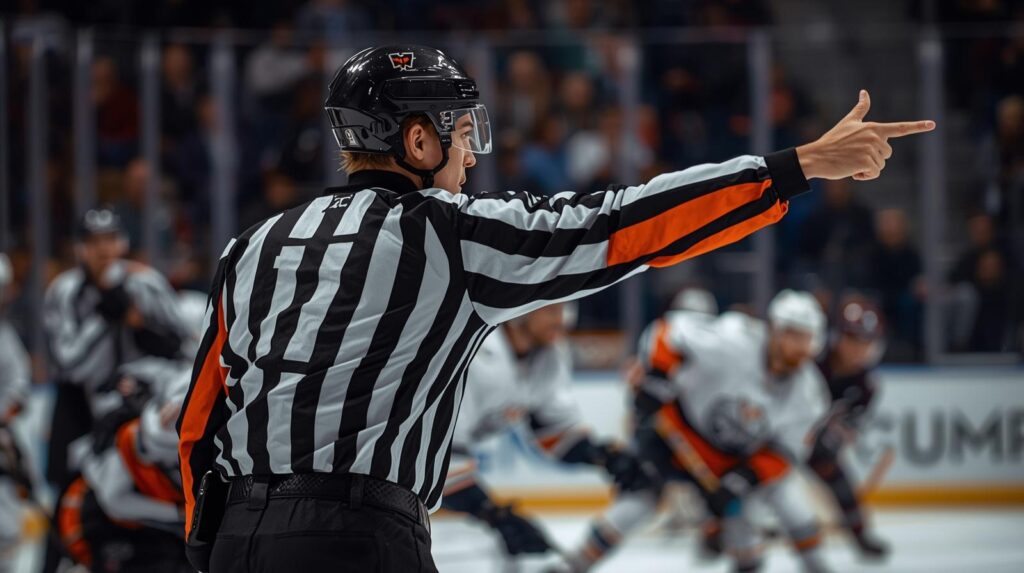
Disputes around Delay of Game usually come from mixing two different logics.
Automatic (“strict”) applications are built so that the referee first checks the conditions of the rule: what exactly the player did, from where, whether play was stopped, whether there were touches, and how it’s described in the code.
Judgment-based applications require context: was there pressure, was there a chance to continue, did the action look like a forced reaction or like a choice to create a stoppage.
Both categories have the same goal—to keep a stoppage from turning into a tool for managing the game outside the hockey play itself.
Common questions about Delay of Game
Does Delay of Game always require intent?
No. Some variants are built as strict liability based on the action itself. In others, intent is inferred through context—then the details of the play matter, not just the outcome.
How is a bench minor different from a regular minor penalty?
A minor penalty is usually assessed to a specific player. A bench minor is team responsibility: it’s served by a designated player, and the reason is often tied to procedure (the bench, line changes, challenges) rather than a one-on-one battle on the ice.
Why is puck over glass penalized if it can be just a mistake?
Because without that provision, a direct send-out becomes too advantageous as a way to relieve pressure. The rule protects hockey’s structure: even an accidental mistake creates a stoppage that changes the dynamics of shifts and attack.
When do they award a penalty shot or an awarded goal instead of two minutes?
In rule sets where it’s provided for, those decisions are usually tied to taking away an obvious scoring chance or preventing a practically inevitable goal. The exact conditions depend on the specific league and the edition of the rules.