The Simple Rule Behind Too Many Players on the Ice
One extra second on a line change can cost more than a big hit or a bad pass. Too Many Men on the Ice is a bench minor that comes not from battling for the puck, but from substitution order: who is allowed to be on the ice at a given moment, and when the player coming on starts to count as part of the play. The core logic is similar across leagues, but the wording and enforcement details depend noticeably on the rulebook—especially when a team pulls the goalie and sends out an extra attacker.
Table of Contents
- What is Too Many Men on the Ice?
- How many players are allowed on the ice in different situations?
- Too Many Men penalty: what it is and who serves the bench minor
- Too Many Men on a line change: why the call is usually about participation
- Too Many Men when pulling the goalie (extra attacker): why the biggest debates happen here
- NHL vs IIHF vs Hockey Canada: how the rule wording and emphasis differ
- Why referees don’t call Too Many Men immediately
- Why Too Many Men keeps happening season after season
What is Too Many Men on the Ice?
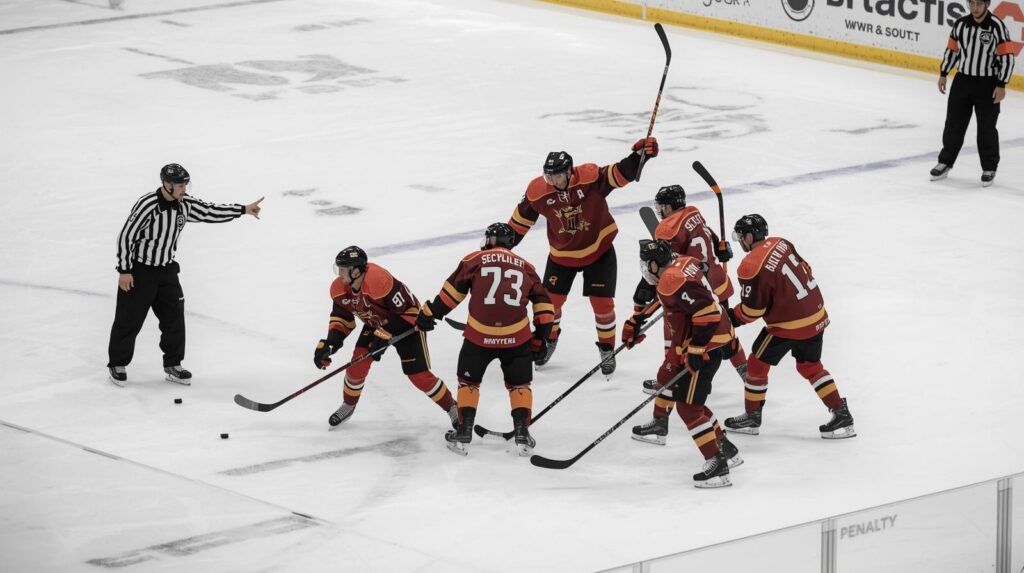
The violation is simply that one team has more players on the ice than the current game situation allows. In practice, the whistle usually isn’t about a “freeze-frame with an extra skater,” but about interference with the play: the extra player plays the puck, engages in a battle, blocks an opponent, or otherwise affects how the attack or defense develops.
That’s why controversial moments almost always come down to how the word “participates” is interpreted. In rulebooks, the emphasis is typically on illegal participation/interference and gaining an advantage from the extra player, not on the fact that someone physically happened to be on the ice during a change.
How many players are allowed on the ice in different situations?
At 5-on-5, the standard setup is five skaters and a goalie. On the penalty kill, the number goes down according to the permitted format (often four or three skaters), but the specifics depend on how the league handles coincidental penalties and what limits exist on combinations of penalties. In practice, it’s more useful to think not “minus one automatically,” but “the number is determined by the current game format under that competition’s rules.”
When a team pulls the goalie and adds an extra skater, the general principle is the same: the total number of players on the ice still has to stay within what’s allowed, with the goalie’s spot temporarily taken by a skater. The trickiest part is the transition between the goalie and the extra attacker: in different codes it’s described differently than a normal line change, and that’s where disputes most often arise.
Too Many Men penalty: what it is and who serves the bench minor
In most professional and international rule sets, the basic sanction is a two-minute bench minor. It’s treated as a team penalty because it’s tied to the bench and the substitution procedure, but it’s served by a specific player selected under the rules of that particular league.
How that penalty “behaves” after a goal is scored generally follows the logic of standard two-minute minors that create a power play: it often ends if the opposing team scores. With stacked penalties and depending on the edition of the rules, there can be nuances, so it’s more accurate to say “usually” rather than “always.”
Too Many Men on a line change: why the call is usually about participation
Most Too Many Men calls are a product of line changes. The typical scenario looks the same: a player comes on too early and manages to get involved in the play while the player being replaced hasn’t completed the change under the rulebook’s criteria.
In the North American tradition (including NHL-type rules), people often discuss the “5 feet / about 1.5 m” guideline from the bench: the player coming off must be in the immediate vicinity of the bench and not participating in the play, so that the early arrival of the replacement doesn’t become a violation. This criterion is characteristic of NHL-type wording; in IIHF rules the substitution logic is described differently and doesn’t always rely on a specific distance as the central condition.
Regardless of the code, the officiating logic is usually the same: if the departing player starts playing the puck or impeding an opponent before the change is objectively complete, it’s no longer a “tight change,” but an extra participant in the moment.
Too Many Men when pulling the goalie (extra attacker): why the biggest debates happen here
A situation where the extra skater is already engaged while the goalie hasn’t reached the bench yet looks like an automatic penalty—hence the constant debate. At the same time, it’s important not to create the false impression that pulling the goalie comes with some “special punishment” like “disallowing a goal instead of two minutes.” In most standard codes, the basic response to an extra player who interferes with the play is the same bench minor for too many men/players.
So why do breakdowns sometimes sound like “the goal was disallowed and there was no penalty”? Most often it’s about chronology and how the moment is classified. The play may have been stopped by the whistle before the puck actually crossed the line due to illegal participation/substitution—and then the goal can’t count because play was already dead. In other cases, the incident may be written up under a different provision in that specific rulebook (for example, illegal substitution/illegal participation), where the consequences depend on the league and the particular edition of the rules.
The practical test still comes down to one thing: when the extra attacker starts participating before the substitution is completed under the rules, the team has an extra participant in that moment—and that becomes the trigger for a sanction.
NHL vs IIHF vs Hockey Canada: how the rule wording and emphasis differ
The phrase Too Many Men on the Ice is historically more tied to the NHL and North American terminology; in international and national usage, Too Many Players is often used. The substance is the same: a team violation for having too many players on the ice.
In IIHF, too many men/players is typically assessed as a two-minute bench minor, and questions of changing and involvement are described through the order of coming on and going off, and interference with the play. In NHL-type rules, public disputes more often concentrate on the moment of the change and participation criteria, including nuances when the goalie is pulled. In Hockey Canada materials, you can see more attention paid to change discipline and to the idea that the problem isn’t an extra body on the ice, but interference with the play.
Why referees don’t call Too Many Men immediately
Changes happen at speed, and officials need to separate a technical change that doesn’t affect the play from a situation where the extra player truly becomes part of the moment. That’s why in games you often see the reaction come not to the fact of the change itself, but to the interference: touching the puck, actively joining the battle, creating an obstruction.
That also answers a common question about video review. The set of situations that can be challenged (coach’s challenge) depends heavily on the league: in many competitions it’s limited to offside or goaltender interference, and too many men isn’t a standard basis. At the same time, an illegal change can surface indirectly if a play is being reviewed for another reason—but that’s a matter of the specific rulebook.
Why Too Many Men keeps happening season after season
Too Many Men rarely looks like a blatant brain fade. More often it’s a mismatch of actions: one player is sure the change is already complete, another lingers on the ice for a second, and it’s in that second that the puck ends up nearby. Late in periods, during long shifts, on the penalty kill, and when pulling the goalie, the risk is higher: the pace is higher, the cost of a second is higher, and the team tries to win the moment earlier than the substitution order allows.
The Bruins–Canadiens episode from 1979 is often cited precisely as an illustration of the mechanism: a too many men call late, a power play for the opponent, a converted chance—and the game swings because of an organizational mistake. It’s useful not as a legend, but as a demonstration of why referees watch involvement in the play so closely.