The Surprising Logic of 3-on-3 Hockey: Rules and Strategy
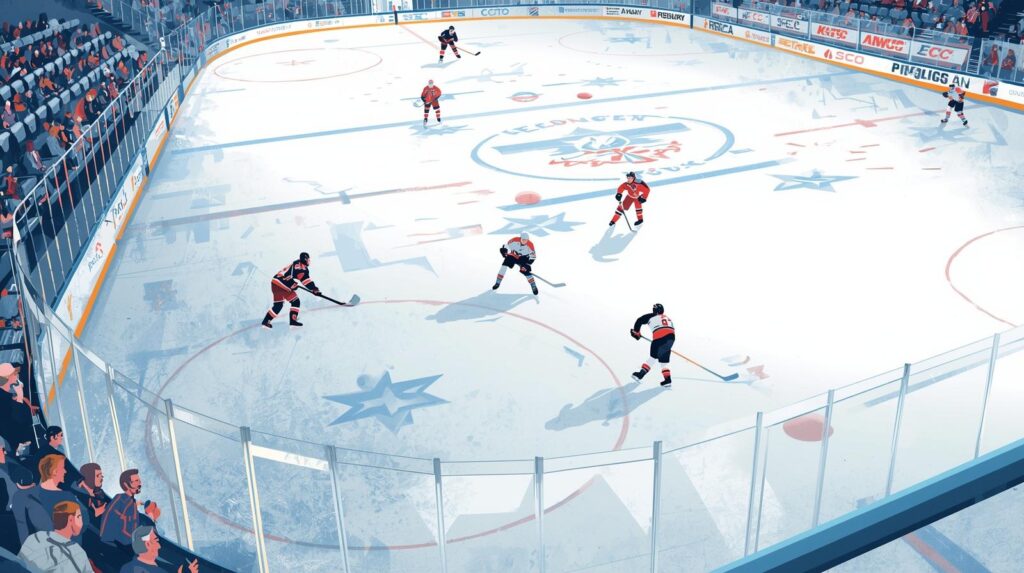
3-on-3 isn’t “simplified hockey.” It’s a format where space, risk, and decision time are distributed differently. Fewer skaters means more open ice, more one-on-one situations, and more sequences where an imprecise pass through the middle turns into a chance at the other end almost instantly. Under the same name, though, you’ll often find different rule sets: full-ice play (for example, overtime in some leagues), half-ice formats, games on shortened rinks, and—at recreational tournaments—extra limits on contact, shots, and restart procedures. Strategy is always tied to how the rules are actually set up in a given league.
Table of Contents
- What is 3-on-3 hockey? Common formats
- 3-on-3 hockey rules: what stays the same and what varies by league
- Lineups, line changes, and restarts
- Body checking, contact rules, and safety
- Offside and icing in 3-on-3 hockey
- The goalie crease and goalie interference
- Penalties in 3-on-3: power plays or penalty shots
- Tag-up and “clear the zone” rules in half-ice 3-on-3
- How 3-on-3 differs from 5-on-5: space, risk, and possession
- 3-on-3 positioning: roles and the “triangle” structure
- 3-on-3 offensive strategy: creating chances with open ice
- 3-on-3 defensive strategy: protecting the middle
- Transition in 3-on-3: the sequence that decides games
- Game management in 3-on-3: score effects and opponent style
- Common mistakes in 3-on-3 hockey
- Typical 3-on-3 patterns (work in many rule sets)
- FAQ
What is 3-on-3 hockey? Common formats
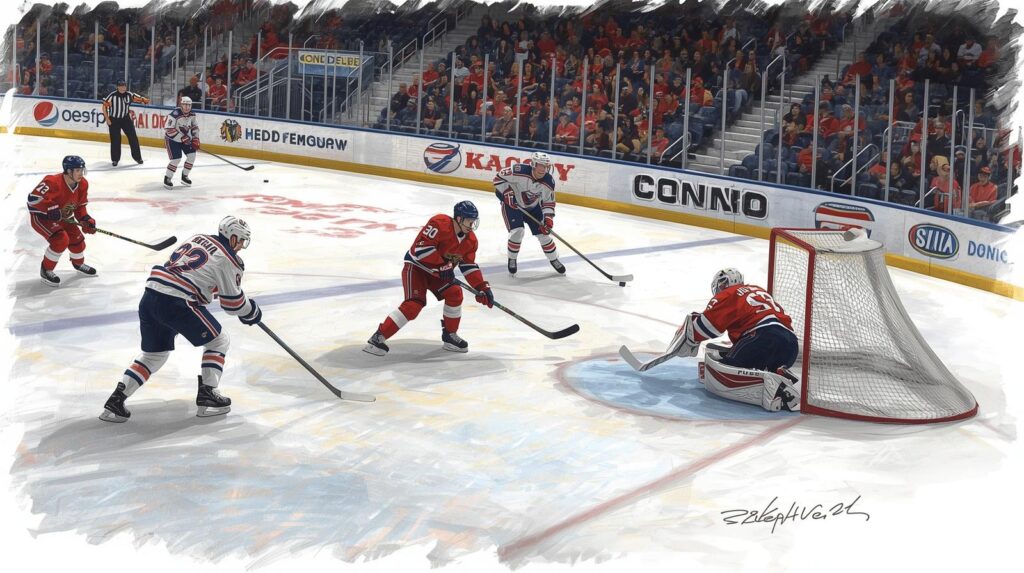
On a full sheet, 3-on-3 usually looks like regular hockey, just with three skaters: more room to turn, a higher cost for mistakes in the neutral zone, and a more visible role for possession. This version is familiar from overtime and from practice segments, although the rule details (time, faceoff procedures, interpretations) can vary.
Half-ice is a separate category. Sometimes it’s played in one end with a single goalie and restarts through the blue line; sometimes it’s two parallel games played crosswise, where each “mini-rink” has its own nets and its own boards/bumpers. Because of the ice dimensions, these formats more often adjust puck-in procedures and how play resumes after whistles to keep the pace up and avoid turning the game into nonstop battles at the net.
There are also in-between options: three-quarter ice, mini-rink, “studio” ice. The spatial logic stays the same, but attack angles change and the share of stop-start sequences grows: less straight-line acceleration, more frequent direction changes.
3-on-3 hockey rules: what stays the same and what varies by league
Lineups, line changes, and restarts
In most rule sets, there are three skaters and a goalie on the ice, and line changes are often allowed on the fly. But that’s not a universal standard: some tournaments restrict changes, use fixed shifts, or apply their own interpretation of when a player counts as “on the ice.” Restarts can also differ—ranging from standard faceoffs to a quick puck placement at a marked spot to avoid long setups.
Body checking, contact rules, and safety
In many recreational and developmental formats, body checking is banned and hard contact is limited. That’s not “a 3-on-3 rule” in general, but a common organizer choice, especially on smaller ice. Where contact is limited, defense is more often built on positioning, angles, and taking away passing lanes rather than using a hit as the way to stop an attack.
Offside and icing in 3-on-3 hockey
There isn’t a single offside/icing model for 3-on-3. On full ice, they often match the rules of the specific league, including differences between North American and international interpretations. In recreational rule sets, offside is sometimes kept as delayed offside, and sometimes removed entirely. In half-ice formats, offside often isn’t used, because the neutral zone and the “attack boundary” work differently, and pace is maintained through other mechanisms.
Icing is similar. In some places it doesn’t exist as a rule; elsewhere, one of the common interpretations is used (touch, hybrid, or no-touch). Whether icing is in effect is a rulebook item, not a “natural consequence” of the markings.
The goalie crease and goalie interference
The goalie crease isn’t a “no-go zone” in the sense of an automatic violation. It’s an area where an attacker’s actions are more often judged through goalie interference: contact, restricting movement, or screening can be interpreted differently depending on the league and the situation. In small-format games, procedural rules are sometimes added after the goalie covers the puck—for example, requiring players to clear space at the net before play resumes. If such a procedure exists, it belongs to that specific tournament, not to “standard” hockey.
Penalties in 3-on-3: power plays or penalty shots
In 3-on-3, especially on reduced ice, tournaments sometimes use a penalty shot or a series of shots instead of a traditional power play. The logic is balance: 3-on-2 or 2-on-2 on small ice can swing a game too sharply and turn it into a chain of special teams situations. Both approaches exist—the rulebook decides.
Tag-up and “clear the zone” rules in half-ice 3-on-3
In many half-ice rule sets, a “reset” applies after a change of possession: the team has to take the puck out over the blue line or “clear” the zone before it can attack again. The details vary. In some rules, simply crossing the line is enough; in others, control over the line is required; in some, extra conditions are added before a shot or before the attack can be completed. Tactically, this changes what possession means: the puck can be under control, but the attack still isn’t considered “allowed” by the rules until the reset requirement is met.
How 3-on-3 differs from 5-on-5: space, risk, and possession
In 5-on-5, player density is higher: more sequences end in battles and coverage support rather than in open ice. In 3-on-3, space becomes an active factor. Turnovers through the middle more often become dangerous counterattacks, and a clean shape after a possession change noticeably reduces the number of “fires” in front of your net.
On full ice, the value of possession is especially clear—not for aesthetics, but because open ice makes it too easy for any mistake to turn into an entry into a dangerous area. On half-ice and mini-rinks, the workload profile changes: fewer long accelerations and more turns, stops, and short bursts that affect decision quality and passing accuracy.
3-on-3 positioning: roles and the “triangle” structure
3-on-3 runs on rotating functions rather than “permanent” positions. Even if someone is formally listed as a defenseman, the situation forces all three players to be support, attack, and a passing option. Most often a triangle forms: one player stays above the puck and offers a safe outlet pass, a second occupies space closer to the net or in the slot, and the third is most often the closest to the puck and connects the other two options.
That geometry affects everything. When two players get too close to each other or move parallel without changing the angle, it’s easier for the defense to close off passes through the middle, and the attacking team runs out of continuation options faster. On smaller ice, this shows up even more sharply: distances are shorter, decisions are faster, and a mistake in body orientation immediately turns into a pass to a player left open.
3-on-3 offensive strategy: creating chances with open ice
Puck speed and timing away from the puck
In 3-on-3, offense often wins not through long individual puck control, but through how quickly the puck switches sides and how synchronously teammates get open for the next pass. Give-and-go passes and changes in attack angle force the defense to choose: pressure the puck carrier or take away the diagonal. While that choice is being made, a window opens for a shot or an entry into a more dangerous area.
Why “reset” is part of the attack
Full-ice 3-on-3 often includes resets: a team enters the zone, evaluates the openings, and then sends the puck back—sometimes even exiting to the neutral zone. It can look cautious, but it usually reflects the real cost of losing the puck through the middle. In half-ice, the reset role can be played by the mandatory puck-out over the blue line: the team isn’t “backing off,” it’s bringing the attack into compliance with the rule set so the next entry or shot isn’t questionable.
Using the space behind the net
The area behind the net is valuable because it changes angles and forces defenders to turn their bodies. In 3-on-3, it often creates more dangerous windows than the perimeter: teammates in front provide options at the near post and far post, and the defense has to hold both the puck and the possible pass into the low slot. On smaller ice, this logic intensifies because the defense almost inevitably compresses toward the net, and any change of direction becomes more noticeable.
Does “shoot from everywhere” always work?
The advice to “shoot more” is sometimes justified: traffic reduces the goalie’s sightline, rebounds stay alive longer, and the defense doesn’t always have time to set a clean block. But a shot becomes a real threat when it’s part of the sequence structure: someone occupies space in front, someone is ready for the rebound, and someone stays above the puck in case of a quick counter the other way. Without that, the shot often becomes a possession trade, and the game turns into end-to-end swings.
3-on-3 defensive strategy: protecting the middle
The temptation in 3-on-3 is to play pure man-on-man and pressure everywhere. It can work if the trio moves in sync and reads switching moments the same way. In practice, a mixed logic is more common: pressure on the puck plus control of the middle and passing lanes. The point isn’t to “allow no shots at all,” but to prevent the pass through the middle to an open teammate, because those passes most often decide sequences in a format with more open ice.
On shortened rinks, the situation where two defenders collapse into the same corner is especially costly. It’s not a prohibition and not a dogma, but an important decision price: that step often opens the slot or the far post, and the offense gets a one-touch passing lane.
Transition in 3-on-3: the sequence that decides games
Switching after a turnover or takeaway happens faster in 3-on-3 than in 5-on-5, because there’s less support coverage. The team that keeps its shape after a change of possession more often avoids a “fire” at its own net. The team that reacts chaotically more often gives up a rush into open ice or a one-touch pass to the far side.
If the rules require a tag-up or a puck-out over the blue line after a possession change, transition becomes double-layered: it’s not only about winning the puck, but also about quickly fulfilling the reset requirement, otherwise possession doesn’t turn into an attack. Under these rules, you can see how a “proper” takeaway produces nothing if the team hesitates for a second and lets the opponent reset.
Game management in 3-on-3: score effects and opponent style
When a team is leading, possession by itself doesn’t guarantee safety. In 3-on-3 it becomes stable when the puck isn’t lost in the middle and the high support layer is kept. Otherwise control easily turns into a trading of chances where one mistake “weighs” too much.
Against an opponent that protects the slot, changes of direction and low-zone attacks work more often: play from behind the net, shifts to the far post, shots through traffic. Against faster teams, the discipline of getting back to the middle usually decides it: better to concede a shot from a bad angle than to open the middle for a diagonal pass.
Common mistakes in 3-on-3 hockey
A turnover through the middle while trying to play “through” the defense often becomes a chance the other way. Double pressure into a corner opens the pass into the slot. Not having a player in front makes many shots too clean for the goalie and defense, which increases the chance of a quick return by the opponent.
Line changes are a separate topic. In 3-on-3, a long shift is more often visible not as “fatigue in general,” but as being late by one step: a passing lane isn’t closed, the return above the puck isn’t made, the cross-ice pass isn’t read. On smaller ice, that step is costly more often than in formats with higher player density.
Typical 3-on-3 patterns (work in many rule sets)
A wide side-to-side switch with a shot through traffic
The offense stretches the defense with a wide pass, then quickly brings the puck back into the middle or up high for a low shot. Two things are usually important in the sequence: net-front work (screen, rebound) and having a player above the puck so you don’t lose the counterattack after a turnover.
Play from behind the net with near-post and far-post options
The puck goes behind the net, and teammates in front create two different angles: near post and far post. The defense has to hold the pass and the shot, and often that body turn costs a fraction of a second.
A moving give-and-go
A pass and an immediate move to get open for the return pass. In 3-on-3, the defense pays faster for losing contact: there are fewer nearby players who can cover the lane.
A wide entry followed by a reset
If there’s no direct window, the team keeps the puck and returns it to a safe point rather than trying to force it through the middle. This is especially noticeable against opponents who read interceptions well and like to break into open ice.
FAQ
Is there offside and icing in 3-on-3 hockey?
It depends on the league and the format. On full ice, the rules are often close to that league’s standard rules. In half-ice, offside is often not used, and tag-up or a mandatory puck-out over the blue line after a change of possession is used instead. Icing may or may not apply—it’s always a rulebook item, not a consequence of the markings.
Why do some 3-on-3 tournaments ban slap shots?
Most often for safety and for controlling play on small ice: slap shots produce harder rebounds and increase injury risk in tight net-front traffic. But it isn’t a mandatory part of 3-on-3—in some leagues, slap shots are allowed.
What does the tag-up rule change in half-ice hockey?
It changes the structure of transitions. After a change of possession, it’s not only important to win the puck, but also to quickly fulfill the rule requirement (take it out over the blue line, clear the zone, reset the attack). If it’s done slowly, possession loses its meaning, the opponent gets time to reset, and more often answers with a counterattack.