Hockey Blue Line Rules Explained: Offside and Zone Entry
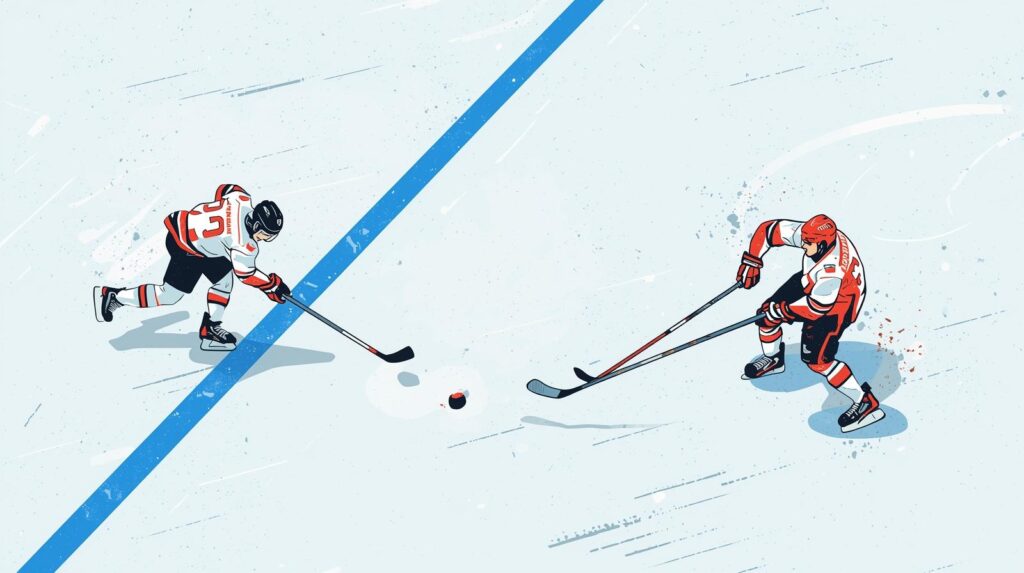
The blue line in hockey does two things at once: it divides the ice into zones and sets the framework for offside. Because of it, some zone entries turn into sustained attacks, while others end with a whistle—sometimes instantly, sometimes after a brief “pause” with the linesman’s arm up. A key part of the nuance depends on the rulebook: NHL, IIHF, and USA Hockey are close in logic, but differ in wording and certain procedures.
Table of Contents
- The Blue Line in Hockey: Zones and Rink Markings
- When the Puck Is in the Zone: “Completely Crossed the Blue Line”
- Offside at the Blue Line: Immediate Offside vs Delayed Offside (Tag-Up)
- Offside Is Determined by Skates, Not the Stick
- Is the Blue Line Part of the Offensive Zone or the Neutral Zone? NHL/IIHF vs USA Hockey
- Determining Edge of the Blue Line: How It’s Applied
- Puck Control on Zone Entries: Where Exceptions Apply
- Tag-Up on Delayed Offside: How Offside Is Cleared
- When Delayed Offside Ends with a Whistle
- Offside, a Shot, and a Goal: What Happens During Delayed Offside
- Intentional Offside: When the Whistle Becomes a Tactic
- Faceoff Location After Offside: Why There’s No Universal Rule
- Why “Holding the Blue Line” Is Strategy, Not a Cliché
- Common Disputed Plays at the Blue Line
- Quick Answers People Commonly Search for About Blue Line Rules
The Blue Line in Hockey: Zones and Rink Markings

On the ice, two blue lines run across the rink and split it into three zones: defensive, neutral, and offensive. In broadcasts you’ll чаще hear offensive/defensive zone; in an international context you’ll hear attacking/defending zone—the meaning is the same, only the familiar terminology changes.
The blue line itself is a wide stripe. In rink-marking standards you usually see a width around 30 cm (often listed as 12 inches). This matters not as a “number,” but as a source of borderline situations: the zone boundary is not a thin thread but a visible band, and the rules have to explain how to read it.
When the Puck Is in the Zone: “Completely Crossed the Blue Line”
In most rulebooks, including the NHL and IIHF, the principle is phrased the same way: the puck is considered to have entered the attacking zone when it has completely crossed the blue line. To exit back to the neutral zone, the puck also has to completely cross the blue line in the opposite direction.
That leads to a typical disputed moment: the puck rolls back toward the blue line and visually “looks like it came out.” If it’s riding along the line or sitting on it, that often means the puck hasn’t left the zone yet, because there was no complete crossing. Wording and diagrams can differ by organization, but the idea of “complete crossing” stays central.
Offside at the Blue Line: Immediate Offside vs Delayed Offside (Tag-Up)
Offside is not a penalty in the usual sense and not an abstract “positioning mistake.” It’s a violation of the order of entry into the attacking zone, judged by the criteria of a specific rulebook.
From there, the application splits into different modes.
In immediate offside, play is stopped as soon as an offside situation is created.
In delayed offside (often called tag-up), the linesman signals with a raised arm, but play may continue. The attacking team gets a chance to clear the offside—usually by having all attacking players fully exit the zone. Until the offside is cleared, the attacking team is limited in how it can participate in the play in the attacking zone, and any “interference” can lead to an immediate whistle.
The difference is especially noticeable when people watch different competitions: the same entry in youth hockey may be whistled right away, while in a pro game it may run as delayed offside with a chance to reset and continue.
Offside Is Determined by Skates, Not the Stick
In the NHL, IIHF, and North American amateur codes like USA Hockey, offside is judged by skate position. Not by the stick, and not by where the body is. So a stick can be in the zone while the player is still considered legally positioned—if, by the skates, he hasn’t fully gone in.
In practice, the common logic is straightforward: a player is considered to be in the attacking zone when both skates are completely on the far side of the blue line. If at least one skate remains on the line or on the neutral-zone side at the moment the puck enters, offside usually isn’t called. The exact wording of what “on the line” means varies across rulebooks, but the two-skate idea is what spectators, players, and officials use as their reference.
In USA Hockey’s officiating explanations on offside, there’s a detail that’s rarely discussed outside officiating circles: skate contact with the ice matters. If the “saving” skate is in the air and not touching the surface/line, the interpretation can become less favorable for the attacker. This isn’t a universal feature of every league, but as an officiating logic it does appear and explains some borderline decisions.
Is the Blue Line Part of the Offensive Zone or the Neutral Zone? NHL/IIHF vs USA Hockey
This is where the confusion most often starts when different sources get blended.
In the NHL and IIHF, a viewer-friendly phrasing is typically used: for the purpose of determining player position, the blue line is treated as part of the offensive zone. So a skate on the line often means the player is not fully in the offensive zone, and therefore not necessarily offside under the two-skate standard.
In USA Hockey, especially in casebook interpretations, you can encounter more detailed language for the “thick line”—through the determining edge and through the principle that how you read the wide line depends on where the puck is. This doesn’t отменяет the requirement that the puck fully crosses the line, but it helps break down plays where the puck and skates end up on different edges of the same wide stripe.
If the article is read as universal, it’s important to keep these approaches separate: what’s described as an interpretation in a USA Hockey casebook shouldn’t be automatically transferred to NHL/IIHF without caveats.
Determining Edge of the Blue Line: How It’s Applied
In interpretations like the USA Hockey casebook, the determining edge explains which edge of the wide blue stripe “settles the question” of the puck entering or leaving.
It’s convenient to tie this to the puck’s direction of travel.
When the puck goes from the neutral zone into the offensive zone, the moment of entry occurs when the puck has completely crossed the edge of the blue line on the offensive-zone side.
When the puck leaves the offensive zone back into the neutral zone, the moment of exit occurs when the puck has completely crossed the edge of the blue line on the neutral-zone side.
This description avoids “farther/closer” formulas and explains well why a puck that’s “creeping along the blue” in many interpretations still isn’t considered out of the zone.
Puck Control on Zone Entries: Where Exceptions Apply
In everyday hockey language you often hear “the puck has to go in first.” That’s a decent explanation for most entries, but in some rulebooks there’s a nuance: a player who has control of the puck may be allowed to cross the line before the puck, provided the conditions described in that specific rulebook are met.
In USA Hockey materials on offside (Rule 630 in the casebook you provided), this approach is expressed through the concept of puck control on entry and through scenarios where a player can “beat” the puck over without creating offside. The same material also shows the limit of the exception—a situation that happens often and looks counterintuitive: if a player carried the puck into the offensive zone, then brought it back out to the neutral zone while keeping his skates in the offensive zone, he puts himself in an offside position. The next time the puck is brought into the zone, it becomes a violation, because the player didn’t return to the neutral zone with the puck.
It’s a good example of how hockey works as a system of zones: even continuous puck control doesn’t “overwrite” boundaries once the puck has already exited to neutral ice.
Tag-Up on Delayed Offside: How Offside Is Cleared
In delayed offside, the attacking team doesn’t get the right to simply “wait it out.” The offside is cleared only after the attacking players fully return to the neutral zone and the offensive zone becomes free of attackers.
Different rulebooks describe this in different language. Some emphasize that players have completely left the zone. In USA Hockey interpretations, there are situations where the blue line is used as a practical criterion for the tag-up moment, because it’s easier to identify than an imagined vertical plane at the boundary.
From a spectator’s perspective, what matters more is this: if even one attacker remains inside the offensive zone, delayed offside usually isn’t considered cleared. That explains plays where one player has already “gotten back,” but the linesman’s arm is still up.
When Delayed Offside Ends with a Whistle
The logic of delayed offside rests on a simple idea: while the attacking team is offside, it shouldn’t affect the play in the offensive zone. So play is stopped when the attacking team, without clearing the offside, touches the puck in the zone or takes actions that prevent the opponent from playing the puck (contact, clear interference, active pressure). The specifics vary by league, but “interfering instead of clearing” is the shared meaning.
In casebook-level officiating explanations (including USA Hockey), practical safety logic is also often added: if offside players, instead of clearing, keep aggressively chasing the puck and the risk of contact rises, the linesman may stop play sooner, even if a defender seems close to the puck. That’s the management side of officiating, not the geometry of the line.
Offside, a Shot, and a Goal: What Happens During Delayed Offside
While delayed offside is in effect, the attacking team generally shouldn’t get an outcome from continuing an offside play. In the USA Hockey explanations you provided, this principle is stated strictly: a goal scored during delayed offside does not count, and the official must stop play if the attack tries to finish the play in the zone without clearing the offside.
In other rulebooks, procedures and wording can differ, so a universal position sounds more cautious: offside is cleared first, and only after that does the zone become a fully “active” area for attack again.
Separately, it’s worth keeping in mind video review of offside where it exists (for example, in the NHL). It doesn’t add new rules to the blue line, but it makes micro-details decisive: the moment the puck enters and skate position, not the general impression that “they probably made it.”
Intentional Offside: When the Whistle Becomes a Tactic
Intentional offside is set aside for situations where the attacking team knowingly triggers a stoppage instead of trying to enter legally. Officials read it through intent: does it look like an effort to create a legal entry, or like a pass/shot “for the whistle,” without a real chance to continue play within the rules.
Consequences differ by league, but the general idea is similar: for intentional offside, the attacking team is typically denied the benefit of a deliberate stoppage.
Faceoff Location After Offside: Why There’s No Universal Rule
The faceoff location after offside is where rulebook differences show up most clearly. Almost everywhere, fixed faceoff dots are used, and the choice depends not on centimeters on the ice, but on the league procedure: where the offside was created, whether it was intentional, whether the team gained territorial advantage, and what additional events occurred around the play.
So the correct universal wording is this: after a standard offside, the faceoff is often set in the neutral zone according to the procedure of the specific league; for intentional offside, the spot is often moved deeper, toward the defensive zone of the violating team. If you need a “faceoff-spot reference,” it’s better done in separate blocks for NHL/IIHF/USA Hockey—otherwise it’s easy to give incorrect specifics.
Why “Holding the Blue Line” Is Strategy, Not a Cliché
The blue line is where an attack either gets established or breaks apart at the edge of the zone. On offense, controlled entries are valued because they more often lead to possession in the zone and set plays. On defense, playing “at the blue line” is a way to break the entry without taking a penalty: the defender manages distance and angle, forcing the attacker either to risk a pass on entry or to settle for a dump-in without control.
That tactical role of the blue line is directly connected to the rules: the cost of a mistake on entry is not just a turnover, but a stoppage or a lost attack with a forced reset out of the zone.
Common Disputed Plays at the Blue Line
Most disputes around the blue line boil down to one thing: what exactly counts as “in the zone” at a specific moment.
The puck is rolling along the blue line. Visually it seems like the zone is lost, but the complete-crossing criterion usually decides it.
One skate on the line, the other in the zone. In many interpretations this keeps the player onside, because he isn’t fully in the offensive zone under the two-skate criterion.
A skate above the ice. In USA Hockey explanations, there is an approach where contact with the ice/line can become decisive when judging a borderline position.
A player brought the puck in, took it back to neutral, and brought it in again without leaving himself. Here intuition argues with the formal logic of zones: once the puck exits to neutral, the player must return, or the next entry creates offside.
A player steps off the bench through a door located in the offensive zone. In USA Hockey Rule 630 materials, this scenario is covered separately: the player is judged like any other attacker relative to offside at the moment the puck enters.
Quick Answers People Commonly Search for About Blue Line Rules
Does the stick count for offside?
In most rulebooks, offside is determined by the skates.
When is the puck considered to have entered the offensive zone?
Most commonly—when it has completely crossed the blue line.
What does tag-up mean?
In delayed offside, it’s when attackers fully return to the neutral zone and clear the offensive zone to cancel the offside before interfering in the play.
Why isn’t the faceoff after offside always “where the offside happened”?
Because the procedure is tied to fixed faceoff dots and to preventing territorial advantage; the details depend on the league’s rulebook.