NHL vs Olympic Rink Size: Key Rules and Differences
Hockey in the NHL and at the Olympics starts the same way: three 20-minute periods of stop time. But the feel of a game changes quickly because of two factors—ice geometry and the tournament rulebook. Even when the rink is close to the North American layout, the Olympics are still an international event built around IIHF logic: officiating procedure, discipline, and rule settings differ from the NHL model people are used to.
Table of Contents
- Milano Cortina 2026: NHL-sized ice and an IIHF-based rulebook
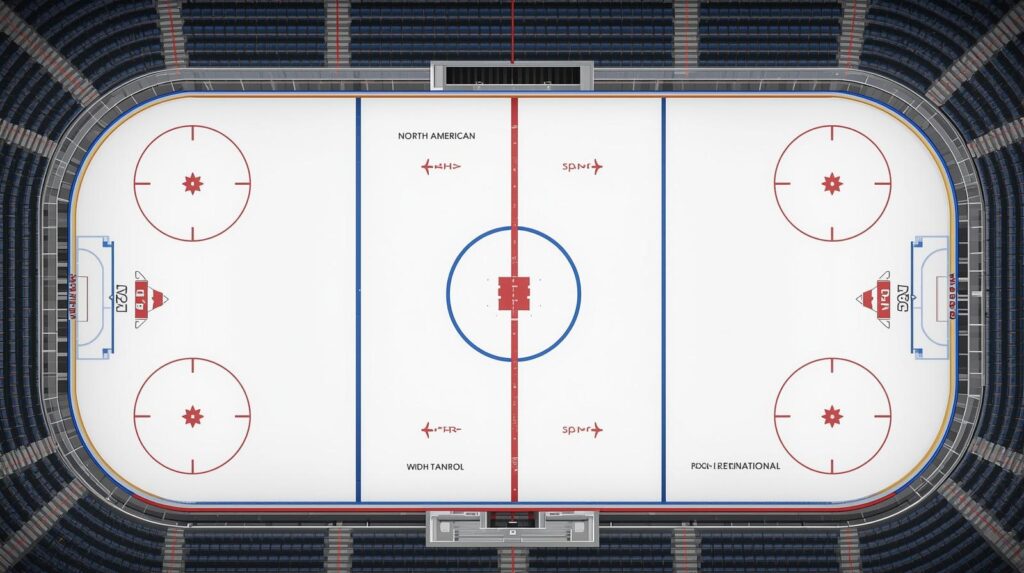
- NHL rink size vs Olympic/IIHF rink size: standard dimensions and allowed variations
- Olympic hockey on NHL-sized ice: why it has already happened
- Hybrid rink widths (90–95 feet): a compromise some venues choose
- Ice markings and zones: why a familiar layout feels different
- NHL rules vs IIHF rules: differences that most often change game flow
- Overtime and shootouts: NHL vs Olympics formats
- Team rosters and intermissions: similar reference points, not one standard
- How rink width changes tactics without “size magic”
- Why North American arenas more often choose NHL-sized ice over Olympic-size
- FAQ
Milano Cortina 2026: NHL-sized ice and an IIHF-based rulebook
For the 2026 Olympics, the most common talking point is the ice size: a narrower, “North American / NHL-style” format is expected. At the same time, the rules and officiating framework remain international (an Olympic rulebook based on IIHF). Saying “strictly 200×85 feet” only makes sense when the parameters of a specific arena are fixed in the tournament’s official documents. In practice, organizers may aim for a North American width, but the final numbers are determined by the venue and technical requirements.
NHL rink size vs Olympic/IIHF rink size: standard dimensions and allowed variations
In North America, the most common standard—usually called NHL size—is 200×85 feet (about 60.96×25.91 m).
The classic IIHF international baseline has historically been associated with 60×30 m (about 197×98.4 feet). At the same time, IIHF can allow tolerances and exceptions in width at certain arenas—more often as a compromise with existing infrastructure than as an equal “second standard.” It also matters that different editions of documents and the practices of different tournaments may define ranges differently, so it’s more accurate to tie exact parameters to a specific competition.
The width difference changes the “price of space.” On wider ice, it’s easier to stretch a defense with cross-ice passes and to hold the puck along the boards longer without immediate contact. On narrower ice, pressure arrives faster: more short collisions through the neutral zone, less time to handle the puck, and more value in one-touch decisions.
Olympic hockey on NHL-sized ice: why it has already happened
Olympic hockey doesn’t always mean a 60×30 m rink. Vancouver 2010 and Beijing 2022 were played on narrower, North American-type surfaces. Usually this has less to do with a “style ideology” and more to do with which arenas are available and how they were designed.
Hybrid rink widths (90–95 feet): a compromise some venues choose
Between 85 feet and “around 98–100 feet,” there are middle-ground solutions—roughly 90–95 feet wide. You’ll see these rinks, for example, in some NCAA venues and in projects where they want more room for combinations but don’t go all the way to a full international footprint because of seating geometry, logistics, and budget. It’s a noticeable but not universal option: it’s better understood as a practical compromise than a mass standard.
Ice markings and zones: why a familiar layout feels different
The marking scheme in the NHL and IIHF is broadly recognizable: the center red line, two blue lines, goal lines, faceoff dots. The nuances start in the details of rule application and officiating procedure—and also in the geometry of each play. Even with the same markings, rink width changes distances: diagonals get “longer,” protecting the middle is harder, and a small loss of gap can open a lane for a pass or shot.
Faceoffs are a good example of differences without “headline” rules. The NHL and IIHF differ in procedural details: warnings, reasons a center can be removed, the sequence at the dot, positioning requirements, and timing. The wording and how strictly it’s enforced depend on the tournament rulebook and officiating interpretation, so it matters more to understand that the differences exist and are felt than to force everything into one universal template.
NHL rules vs IIHF rules: differences that most often change game flow
Fighting and disciplinary penalties
In the NHL, fighting has historically been built into the league’s culture and has its own penalty structure. In international hockey, the approach is usually stricter: a fight more often leads to heavier sanctions, including a game misconduct, and in some cases disciplinary consequences at the tournament level. The exact wording and penalty ladder are set by the competition’s regulations.
Goalie trapezoid: standard in the NHL, often not used in IIHF
The trapezoid behind the net is a signature part of NHL rules: it limits where a goalie can play the puck. A violation is typically treated as delay of game: the goalie is assessed the penalty, and a skater serves it.
In most IIHF international games, the trapezoid is usually not used. Some tournaments can add special provisions, so the final answer is always tied to the rulebook of the specific competition.
Player equipment and safety rules: differences depend on the tournament category
A simple “who is stricter” answer is rarely universal. Equipment requirements and what a player must do after losing a helmet depend on the tournament category (men’s/women’s, adult/junior) and the current edition of the rules. International events do often feature more directive requirements on certain points, but the details are defined by the specific tournament’s regulations.
Kicking motion goals: interpretation matters more than slogans
Both the NHL and IIHF are sensitive to goals scored with a clear kicking motion, but the wording and the interpretation standard differ. In close calls, the decision comes from the combination of rule text, video review, and how the specific tournament interprets “directing the puck” versus a “kicking motion.”
Penalty shot vs shootout: different mechanisms
A penalty shot is awarded for a foul on an obvious scoring chance. In the NHL and in international rules, it is typically taken by the player who was fouled. Exceptions are possible depending on the situation and the rulebook—for example, if the player is injured and cannot continue.
A shootout is a post-overtime tiebreaker. The team chooses the shooters, and differences between leagues and tournaments usually come down to the series format and procedural details rather than the basic selection principle.
Overtime and shootouts: NHL vs Olympics formats
In the NHL, the model is stable: in the regular season, they typically play 3-on-3 sudden-death overtime for a limited time, then go to a shootout. In the playoffs, there is no shootout: teams play 5-on-5 20-minute overtime periods until a goal is scored.
In the IIHF and at the Olympics, the overtime format usually depends on the tournament stage and the approved regulations. In earlier rounds, formats close to “short overtime + shootout” are common, while medal games in many international formats are more often designed to end with a goal during game play rather than a shootout. Exact numbers and the setup (3-on-3 vs 5-on-5, length, number of shootout attempts) are best tied to the documents for the specific Olympic tournament.
Team rosters and intermissions: similar reference points, not one standard
In the NHL, the game roster is most often 20 players (12 forwards, 6 defensemen, 2 goalies), though certain situations can create exceptions. Intermissions are usually around 18 minutes.
In international tournaments, intermissions are often shorter (commonly around 15 minutes), but that is set by the competition rulebook. Olympic roster limits and differences between the men’s and women’s tournaments also depend on the cycle and the rules of a particular Olympics, so exact numbers are best taken from official sport regulations.
How rink width changes tactics without “size magic”
Wide ice usually increases the value of lateral speed and passing accuracy. It’s easier to stretch a defense, and switching the point of attack more often creates a window for a shot or a slot feed. In positional defense, support coverage and diagonal work become more important: a spacing error turns into a passing lane faster.
Narrow ice speeds up the timing of pressure. That shows up in the forecheck, the frequency of board battles, and the way teams enter the zone: more “dump-ins” and more fighting for second chances, because pauses with the puck appear less often.
Why North American arenas more often choose NHL-sized ice over Olympic-size
The shift toward a narrower rink is usually explained by arena infrastructure and economics, not by an argument about “which hockey is more correct.” Narrower ice is easier to fit into a multi-purpose building, more often lets spectators sit closer to the boards, and provides more flexibility in seating configuration.
At the same time, converting a wide rink to a narrow one isn’t always as simple as moving the boards. It often requires rebuilding the lower bowl, recalculating circulation, evacuation codes, and engineering solutions. That’s why many projects plan for adjustable width in advance, but retrofits still remain complex.
FAQ
What is the rink size in the NHL?
Usually 200×85 feet (≈60.96×25.91 m).
What is the size of an “Olympic” rink?
A common reference point is 60×30 m, but at specific Olympics the dimensions can depend on the arena and the tolerances in the rulebook.
Why does the Olympics sometimes play on NHL-sized ice?
Because the tournament uses existing or purpose-built arenas designed around local standards and multi-use requirements. Vancouver 2010 and Beijing 2022 are clear examples.
Is there a goalie trapezoid at the Olympics?
In the NHL, it’s standard. In IIHF international tournaments, they more often play without a trapezoid, but some competitions can have special provisions, so the answer depends on the tournament rulebook.