All About Ice Hockey: Complete Beginner’s Guide
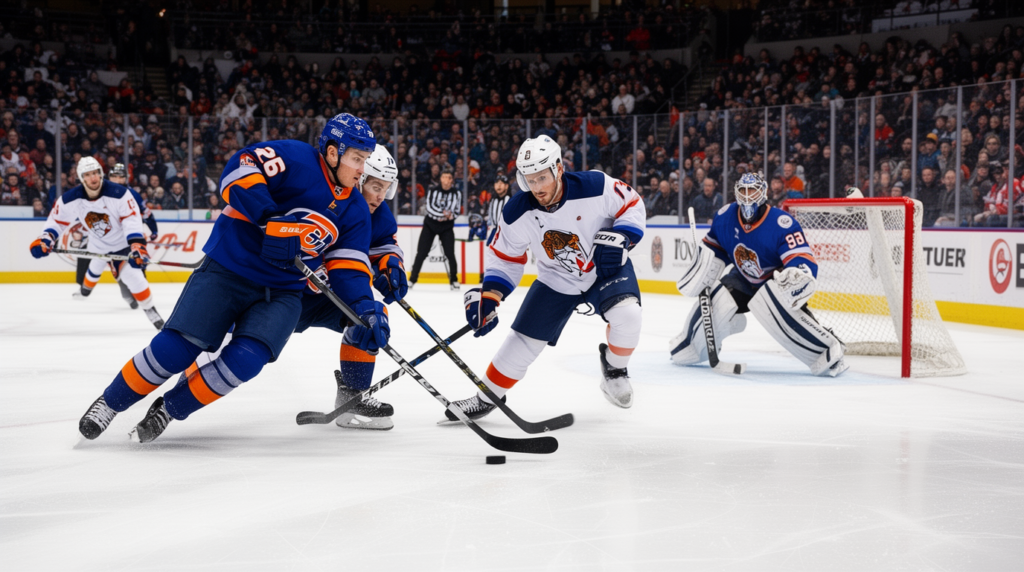
Ice hockey is a team sport in which two teams on skates try to score the puck into each other’s goal using sticks. Six players from each side are on the ice at the same time, and the entire game is built on a combination of speed, precision, and coordinated teamwork. It sounds simple — and it truly is: the objective is clear, while the deeper layers reveal themselves gradually as you watch or play.
But hockey has one defining feature that sets it apart from any other team sport: everything happens on ice. Gliding, sharp accelerations, instant turns — movement here works differently, and that difference creates the tempo fans recognize. Even a short attack can move from one end of the rink to the other in just a few seconds, and this sense of constant motion accounts for much of the game’s appeal.
Ice hockey is not only about shot power or skating speed. It is about moments when everything comes together: a precise pass, proper positioning, the right choice of timing. That is why people attending a game for the first time often say the same thing: everything is understandable, yet there is an immediate desire to dig deeper.
This section serves as a starting point — a simple definition that removes unnecessary complexity and highlights the essence of the game without overloading it with details. From here, the discussion moves step by step through history, rules, player roles, and tactics, forming a complete picture of how hockey works.
Origins and History of Ice Hockey
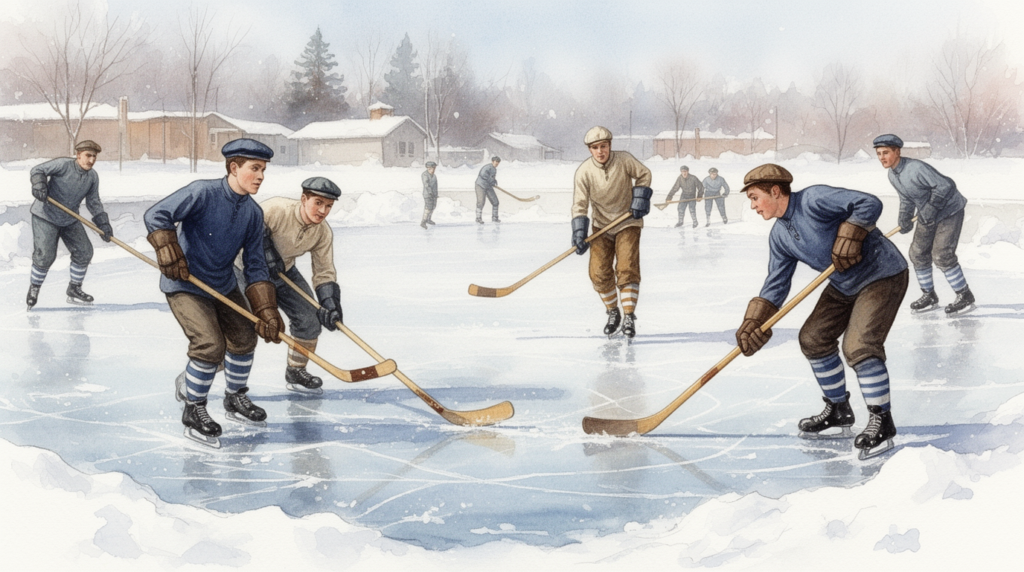
Tracing hockey’s path backward reveals a history longer and more diverse than it might seem. People played various forms of stick-and-ball games long before arenas and modern rules existed. In Europe, such games were known as early as the Middle Ages, while Indigenous peoples of North America had their own competitions built on similar principles — fast movement, passing, and attempts to send a small object into a target.
By the early nineteenth century, features closely resembling modern hockey began to take shape in Canada. One of the earliest references is linked to a game played in Nova Scotia and associated with the Mi’kmaq people. It was played on ice using wooden sticks and small blocks instead of a ball. Over time, elements of British games were added, including methods of starting play and basic principles of contesting possession. The structure evolved, but the overall character remained recognizable: team movement, improvisation, and an ability to read open space.
The year 1875 is commonly considered a milestone — the date of the first documented indoor game, played in Montreal. It demonstrated not only interest in the new sport but also the need to regulate what was happening on the ice. Within a few years, the first sets of rules appeared, defining team composition and limiting chaotic elements inherited from various folk games. Changes came quickly: rink dimensions were adjusted, penalties introduced, and player and goaltender roles clarified.
By the end of the nineteenth century, the game had taken on familiar characteristics and began spreading rapidly across Canada. Clubs were formed, regular matches were held, and trophies emerged. In 1893, the Stanley Cup was established — an award that would later become a symbol of the sport’s highest competitive level. Hockey was gradually transforming from a local pastime into an organized sport with teams, schedules, and its own culture.
In the early twentieth century, rules continued to evolve, often influenced by competing leagues. Different organizations interpreted offside differently, allowed or restricted goaltender movement, and experimented with the number of players on the ice. Some innovations endured, others disappeared, but this period brought the game much closer to its modern form: faster, more structured, and more understandable for spectators.
When the National Hockey League was founded in 1917, hockey already stood firmly as a mass, fully developed sport. What followed was refinement: improvements in equipment, construction of arenas, international tournaments, and expansion beyond North America. Yet the foundation for all of this had been laid long before cameras, broadcasts, and professional contracts — on the ice, where people in different parts of the world gradually arrived at the same idea: to play together and compete.
How Hockey Works
Game Flow
A match begins with a faceoff — the referee drops the puck between two players, and both teams immediately battle for possession. From there, the game moves in waves: attack, counterattack, short stoppages, line changes. Everything happens quickly, but the structure remains consistent: a team tries to move the puck forward, create a shooting opportunity, and prevent the opponent from doing the same.
The puck can travel through the air, bounce off the boards, or change direction after contact — all part of the game’s dynamic nature. Transitions between attacks often take only seconds, making it essential not only to control the puck but also to play effectively without it — occupying proper positions, blocking passing lanes, and returning to defense on time.
How Goals Are Scored and Games Are Won
A goal is awarded when the puck completely crosses the goal line. This can happen after a long-range shot, a rebound, or a well-timed pass into shooting position. Officials ensure that the puck is not scored in violation of the rules, such as being kicked in or played with a high stick.
The outcome of a match is straightforward: the winner is the team that scores more goals. Ties are rare in hockey, as most leagues use overtime or shootouts to determine a winner.
Game Length: Periods and Playing Time
A standard game consists of three periods of 20 minutes of stop time. “Stop time” means the clock pauses during every stoppage — icing calls, penalties, faceoffs, dislodged nets, and other interruptions.
There are intermissions between periods, usually around 15 minutes. During this time, the ice is resurfaced and teams adjust tactics.
It is important to note that the real-world duration of a game exceeds an hour: including intermissions and stoppages, a match typically lasts about two to two and a half hours.
Overtime and Shootouts
If the score remains tied after three periods, the game proceeds to overtime. The format depends on the league, but it is often a short extra period with fewer players on the ice — for example, three-on-three. This opens space and increases the likelihood of a quick decision.
If overtime does not produce a winner, a shootout follows — a series of one-on-one attempts against the goaltender. Selected players take turns attacking individually. The series continues until one team gains an advantage.
Shootouts do not reflect the full structure of hockey, but they provide a clear and decisive way to determine a winner when teams have been evenly matched.
Ice Hockey Rink and Equipment
Ice Hockey Equipment
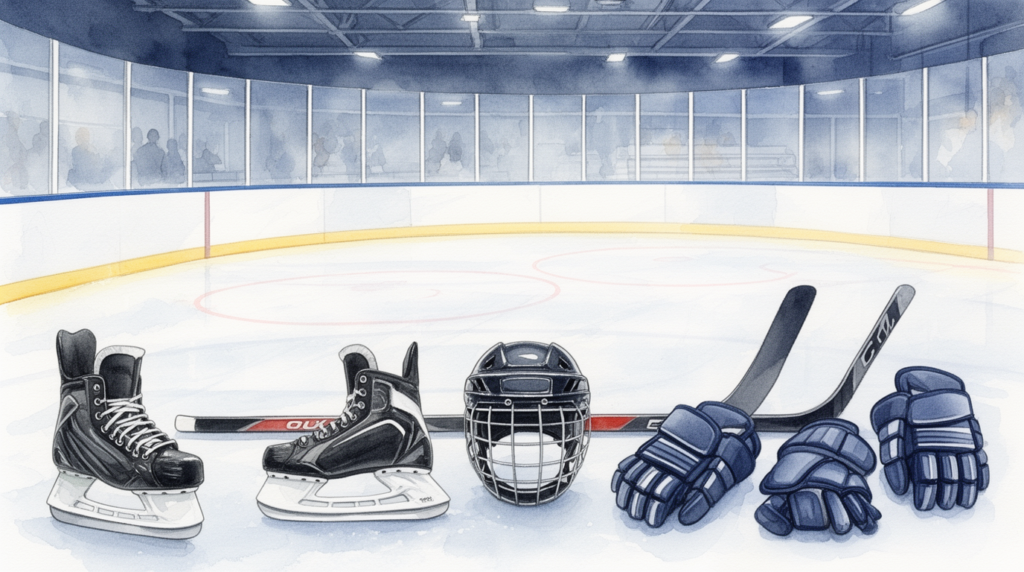
Hockey is a fast, physical sport, and equipment here is not an accessory but a working tool. It protects players, supports movement, and directly affects puck control.
The standard set includes:
- Skates. The foundation of everything — determining speed, balance, and the ability to change direction sharply.
- Stick. The tool for passing, shooting, and handling the puck, selected based on height, position, and playing style.
- Helmet. A mandatory safety element, often with a visor or cage.
- Shoulder pads and elbow pads. Protect the upper body and arms during contact and falls.
- Gloves. Protect the hands while maintaining feel and control of the stick.
- Shin guards. Cover the knees and lower legs, among the most vulnerable areas.
- Hockey pants. Protect the hips, lower back, and tailbone.
- Protective cup and neck guard. Small but important items often overlooked until a hard collision occurs.
Goaltenders use a separate set of equipment — heavier and more specialized. Their role is not about speed across the rink, but about sealing angles and reacting to shots.
For understanding the game, one thing is enough to know: equipment does not slow hockey down. It allows the sport to be played at high speed with physical contact and minimal stoppages due to injury.
Ice Hockey Rink Layout
Hockey is played on a rectangular ice surface with rounded corners, surrounded by boards and protective glass. These elements are part of the game: the puck is often played off the boards, and rebounds create unexpected continuations of attacks.
The rink is divided by lines into functional zones:
- The center line divides the ice in half and is used for the opening faceoff.
- Blue lines define offensive and defensive zones and are directly tied to the offside rule.
- Goal lines and faceoff markings determine restart locations after stoppages.
- The crease marks an area where special rules apply to attacking players.
Rink dimensions vary by league and region. North American rinks are generally narrower and more compact, while European rinks are wider. This affects playing style — more physical battles and shots in some leagues, more movement and combinations in others.
What matters is not memorizing measurements, but understanding the logic: markings help officiate the game, control player positioning, and maintain high tempo without chaos.
Read more about Ice Hockey Rink
Key Hockey Skills
Hockey is often perceived as fast and physical, but behind that impression are very specific skills. These determine how a player moves on the ice, interacts with the puck, and finishes attacks. Understanding these elements helps read the game, even from the stands.
Skating in Ice Hockey
Skating is the foundation of hockey. Unlike recreational or figure skating, the focus here is not smoothness but constant readiness to change speed and direction. Players rarely move in straight lines: they accelerate, stop abruptly, pivot, skate sideways or backward while maintaining balance.
A defining feature of hockey skating is a low stance and active leg work. This allows players to absorb contact, react quickly to changing situations, and stay stable in battles. Speed matters, but the ability to control movement in tight spaces under pressure matters even more.
Stickhandling and Puck Control
Stickhandling is central to hockey. It includes puck carrying, passing, and receiving. The focus is not on flashy dekes, but on maintaining control while moving, under pressure, and in tight board battles.
The puck is almost never in ideal conditions. Ice is uneven, opponents apply constant pressure, and decisions must be made in fractions of a second. As a result, valuable skills include handling the puck without constant visual focus, using the body to shield it, and executing short, precise passes. Strong puck control directly affects game tempo and the number of scoring chances created.
Shooting in Ice Hockey
A shot is the natural conclusion of an offensive sequence. In hockey, shots are judged not only by power, but by release speed, accuracy, and timing. Even a modest shot can be effective if taken unexpectedly from a favorable position.
Different shot types are used in different situations: off the rush, after a pass, near the net, or from distance. A successful shot begins with body balance, proper stick positioning, and the ability to act without delay after receiving the puck. This preserves attacking momentum and makes the goaltender’s job more difficult.
Ice Hockey Positions
Six players from each team are on the ice at the same time, and each occupies a defined position. These roles are not isolated — players constantly rotate, adjust to situations, and support one another. Still, understanding positions provides a clear view of how team play is structured and why players act as they do.
Forwards
Forwards are primarily responsible for offense and creating scoring chances. Typically, three forwards are on the ice: a center and two wingers.
The center often initiates play, supports defense, and connects offensive and defensive actions. Centers work across the entire rink, take faceoffs, and are often the first to return defensively after a turnover.
Wingers focus more on pressure in the offensive zone. They find passing lanes, take shots, and battle along the boards. In modern hockey, the distinction between center and wing is fluid and depends heavily on the situation and the team’s system.
Defensemen
Defensemen play closer to their own net and are responsible for stopping the opponent’s attacks. Their role is not limited to preventing shots — they also initiate their team’s offensive play.
Typically, two defensemen are on the ice, one on the left and one on the right. They control space in front of the net, intercept passes, block shots, and move the puck out of the defensive zone quickly. In positional offense, defensemen often join the attack and shoot from the blue line.
A strong defenseman is not necessarily the most physical player. Reading the game, positioning, and decision-making under pressure are far more important.
Goaltender
The goaltender is the last line of defense and the only player with a fundamentally different role. They protect the net and react to shots that can come from unexpected angles.
Most of the time, the goaltender operates within the crease, managing angles, rebounds, and puck movement near the net. Modern goaltenders also participate actively in the game: stopping the puck behind the net, initiating plays with passes, and communicating with defensemen.
Although the goaltender stands apart, their performance is tightly linked to team play. Solid defensive structure directly affects how comfortable and effective they can be during a game.
More about positions in ice hockey.
Essential Ice Hockey Rules
Hockey is fast-paced, but several core rules shape player movement, attacking patterns, and the flow of each shift. Knowing these principles helps explain why plays develop the way they do.
Offside Rule
Offside governs how a team enters the opponent’s zone. It occurs when an attacking player crosses the blue line before the puck. The position of the skate matters — if at least one skate remains on or behind the line, the player is considered onside.
The purpose of the rule is to prevent attackers from setting up near the net in advance. When offside is called, play stops and a faceoff takes place outside the offensive zone. In modern leagues, offside calls are often reviewed by video, as decisions can depend on centimeters.
Icing Rule
Icing is called when a player shoots the puck from their own half of the rink across the opponent’s goal line without it being touched. This is considered a violation because it allows a team to escape pressure too easily.
After icing, play returns to the zone of the team that committed the infraction, and that team is not allowed to change players. This makes icing a significant tactical restriction, maintaining tempo and discouraging repeated long clears.
Penalties and Infractions
Penalties are assessed when a player violates rules governing physical play or obstructs an opponent illegally. There are many types of infractions, but several are particularly common:
- Tripping — using the stick or skate to knock an opponent down.
- Holding or hooking — restricting an opponent’s movement.
- Boarding — a dangerous hit into the boards.
- High-sticking — playing the puck above shoulder level when it results in contact.
Most infractions result in two minutes of shorthanded play. More severe incidents can lead to five-minute penalties or ejection from the game.
Special teams situations are tactically important: the shorthanded team adjusts defensively, while the team on the power play seeks to exploit space and create shooting opportunities.
What a Typical Ice Hockey Game Looks Like
Although hockey may appear chaotic, it follows a clear sequence of events. A game revolves around repeating cycles: faceoff — play — stoppage — line change — play again. This creates a recognizable rhythm.
Opening Faceoff
The game begins with a faceoff at center ice. The referee drops the puck between the two centers, setting the tempo for the opening seconds. The team that wins possession often tries to establish early control or push play into a favorable zone.
The opening faceoff is not ceremonial. It frequently shapes the early minutes, especially in fast-paced leagues where every possession can lead to a scoring chance.
Game Flow During Play
After the faceoff, the main cycle begins. Teams alternate puck control, transition between offense and defense, and move quickly through zones. The game unfolds rapidly: several passes, zone entry, a shot attempt, board battles, and a change of direction.
Several recurring elements appear during regular play:
- entering the offensive zone across the blue line;
- puck movement within the zone to create shooting lanes;
- turnovers followed by quick defensive recovery;
- pressure along the boards and battles for loose pucks.
Despite this structure, every sequence is unique — that unpredictability is part of hockey’s appeal.
Stoppages in Play
Hockey does not flow continuously. Stoppages occur for icing, offside, the goaltender freezing the puck, penalties, or the puck leaving the rink. Most stoppages result in a faceoff at the nearest dot.
The nature of stoppages affects game tempo. Frequent shots and net-front pressure create a choppier rhythm. Sustained offensive-zone play leads to fewer stoppages and more on-the-fly line changes.
Line Changes
Line changes are one of hockey’s defining features. Unlike many sports, players leave and enter the ice during play, with teammates stepping on as others exit. These changes happen in short intervals, typically every 30–60 seconds.
Why so often?
The pace is intense, physical demands are high, and a fresh forward line or defensive pair can immediately alter the momentum of a shift.
During stoppages, coaches use the opportunity to deploy specific combinations. This becomes especially important during penalties, late-game situations, or offensive-zone faceoffs.
Ice Hockey Strategy and Tactics
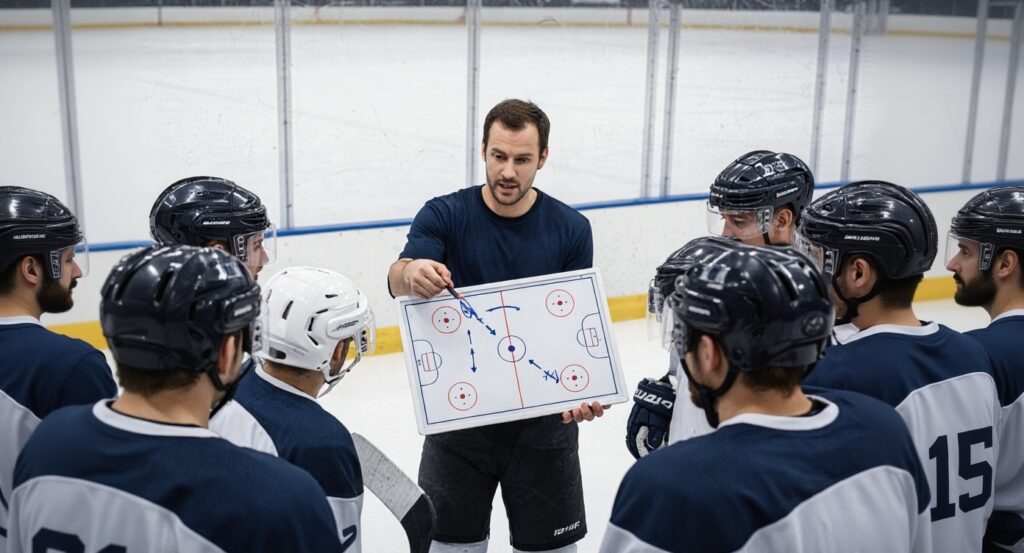
Hockey is not only about speed and physicality. Beneath the on-ice action lies a structured system: player positioning, puck movement, and space creation. Strategy does not exist separately from skills — it transforms individual actions into a cohesive system.
Offensive Strategy
On offense, teams aim to achieve two goals: enter the opponent’s zone with control and create conditions for a dangerous shot.
Controlled zone entries. Teams prefer short passes or individual plays to maintain possession. Dump-ins are used selectively, usually when lanes are closed.
Three-point attack structure. This typically includes a puck carrier, a player near the net, and a teammate on the weak side. This formation stretches defensive coverage and opens shooting and passing options.
Off-puck movement. Forwards constantly shift along the boards, cut into the slot, or move high to offer passing lanes. Space is the core resource of offense, and movement creates it.
Shots through traffic. Teams often intentionally screen the goaltender to obstruct vision. Blue-line shots and rebounds remain effective tools.
Defensive Strategy
Defense in hockey is not simply about taking the puck away. It is a coordinated effort to limit space and force unfavorable decisions.
Position control. Defensemen protect the area in front of the net and deny the center of the zone, where shots are most dangerous.
Neutralizing zone entries. Teams guide attackers toward the boards, where pressure and interceptions are easier.
Support coverage. When one defenseman engages, the partner stays closer to the net. Forwards also assist deep in the zone to prevent overloads.
Forechecking and pressure. Depending on the situation, a team may apply aggressive pressure or fall back into a compact defensive structure.
Team Structure on the Ice
Teams operate as five-player units. Even at high speed, play follows structural principles.
Triangles and passing lanes. Players position themselves to maintain multiple passing options, increasing puck stability and reducing interception risk.
Balance between forwards and defensemen. When one defenseman joins the rush, the other provides coverage. Similarly, if a forward drives deep, teammates adjust for retrieval and defensive recovery.
Transition from offense to defense. Turnovers are critical moments. Many systems rely on immediate pressure from the nearest player while others retreat into compact coverage.
Flexibility. Hockey lacks rigid assignments. Players constantly adapt to the situation, using structure as a guide rather than a constraint.
Professional Ice Hockey Leagues and Competitions
Hockey develops at many levels, but the professional stage sets benchmarks for speed, skill, and preparation. Leagues worldwide shape seasonal calendars, define playing styles, and serve as showcases for elite talent. Several structures hold particular prominence.
NHL: The World’s Leading Hockey League
The NHL is considered the strongest hockey league in the world, featuring teams from the United States and Canada and players from dozens of countries.
During the regular season, teams compete for playoff positions, culminating in the Stanley Cup — one of the most recognizable trophies in sports.
Key characteristics include:
- a dense schedule and high-intensity competition;
- a blend of North American physicality and European technical influence;
- a comprehensive player development system through affiliate teams.
Even casual observers often recognize hockey through the NHL due to its media presence and long-standing traditions.
International Ice Hockey Tournaments
Alongside club leagues, national-team tournaments play a major role. They bring together elite rosters, and stylistic contrasts often lead to unpredictable games.
Key events include:
- IIHF World Championship — an annual tournament featuring teams from top-tier nations to developing programs;
- The Olympic Games — a rare opportunity to see top players represent national teams, particularly when NHL participation is allowed;
- IIHF junior tournaments, where future stars often emerge.
International competitions highlight how differently hockey is played across countries — and how those styles influence one another over time.
Major European Hockey Leagues
Europe plays a central role in the hockey ecosystem, with strong national leagues and distinct traditions.
Prominent leagues include:
- KHL — an international league with teams from multiple countries, emphasizing structured, combination-based play;
- SHL (Sweden) — known for strong youth development and player preparation;
- Liiga (Finland) — one of Europe’s most organized leagues and a frequent source of NHL talent;
- NLA (Switzerland) — a fast-growing, entertaining league gaining competitive strength.
European leagues vary in pace, physicality, and tactical emphasis, but all are essential to the global development of hockey. Many NHL stars begin their careers there.
Popularity of Ice Hockey
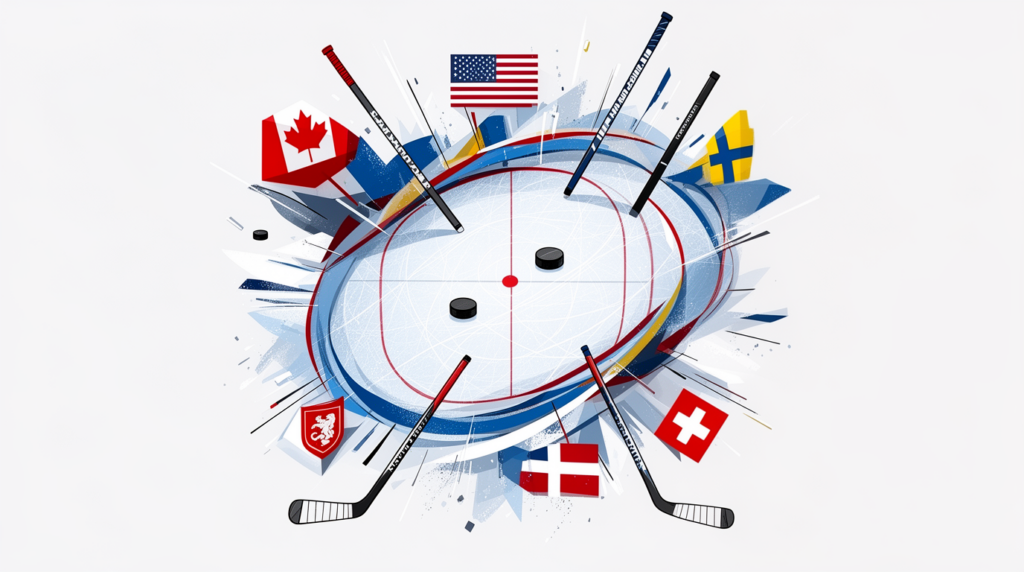
Hockey’s popularity has been shaped not only by strong leagues, but also by climate, sporting traditions, and infrastructure. As a result, the sport has developed a clear geography: countries where hockey is embedded in culture, regions where interest is growing, and audiences increasingly consuming hockey through digital media.
Countries Where Ice Hockey Is Most Popular
Hockey is deeply rooted in regions with both natural conditions and established sports systems. In these countries, it is not a niche sport but part of public life.
The strongest hockey cultures include:
- Canada — where hockey functions as a national symbol;
- The United States — with a vast audience, extensive league systems, and collegiate hockey;
- Russia — with long-standing traditions and high-level training;
- Sweden and Finland — featuring stable national programs and strong domestic leagues;
- Czech Republic and Switzerland — known for deep hockey culture and quality youth development.
These countries consistently produce NHL players and influence global hockey trends.
Growth of Ice Hockey in New Regions
As infrastructure expands, hockey is growing in regions where it was once considered exotic. Development programs, federation efforts, and international success have fueled this growth.
Rapidly expanding areas include:
- the southern United States (Texas, Nevada, Florida), driven by NHL club success;
- Asia, with development programs in China, South Korea, and Japan;
- Central Europe, with increasing clubs and fan bases;
- the Middle East, with early professional projects and new arenas.
Geographic expansion affects playing styles, introducing greater tactical diversity.
Media, Culture, and Fan Experience
Modern hockey has expanded significantly through media. Broadcasts, analytics, digital statistics services, and strong social media engagement have made the sport accessible even where ice rinks are scarce.
Additionally:
- arena presentation enhances the entertainment aspect;
- younger audiences consume content in shorter formats, prompting leagues to adapt;
- documentary and behind-the-scenes projects offer insight into team operations, increasing engagement.
Hockey has become not only a sport but part of the entertainment industry — a key factor in its sustained growth.
Final Thoughts on Ice Hockey
Ice hockey is often associated with speed, physical play, and the emotion of the crowd. Yet beneath that surface lies a carefully structured system: rules that maintain order, roles that bind a team together, and tactics that turn motion into purposeful play.
Understanding how hockey works changes how a game is perceived. Attention shifts from the puck alone to space, off-puck movement, and decisions made in fractions of a second. The game becomes readable without becoming predictable — that balance is part of its appeal.
Hockey continues to evolve: styles shift, geography expands, audiences grow. Still, its foundation remains unchanged — teamwork, quick thinking, and the constant balance between risk and discipline. That is what makes hockey one of the most dynamic and layered sports.