Hockey Faceoff Circles and Dots Explained
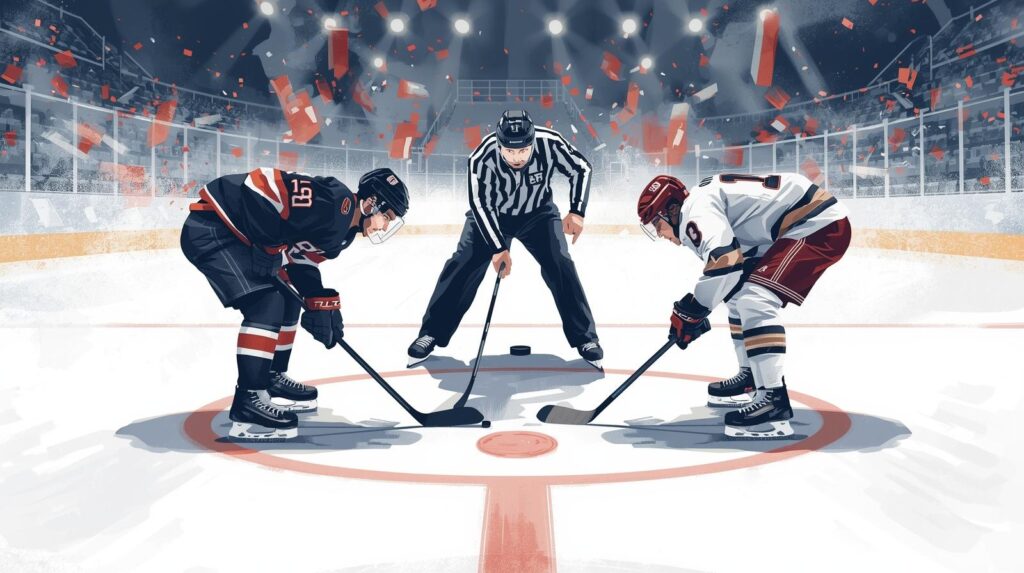
A faceoff in hockey is tied not to a “convenient spot” but to the markings: dots, circles, and the lines around them. Officials assign the dot by the rules—depending on why play was stopped and which team caused that stoppage. The overall logic is similar across the NHL, IIHF, USA Hockey, and other rulebooks, but the details (procedure, dot relocation, consequences for violations) differ noticeably, so in disputed situations the correct answer almost always starts with: “under this league’s rules…”
Table of Contents
- What Is a Faceoff in Hockey and Why the Faceoff Location Affects the Game
- Faceoff Dots and Circles on the Ice: How Many There Are and Where They Are
- Faceoff Dot vs Faceoff Circle: What’s the Difference?
- Faceoff Markings Explained: Hash Marks and Lines Around the Dot
- Who Determines the Faceoff Location and Who Drops the Puck
- Faceoff Dot and Circle Dimensions: What the Rulebook Specifies (and Why You Can’t Generalize the Numbers)
- How Faceoff Locations Are Set After a Stoppage in Play
- Faceoff Procedure and Violations: Why a Player Is Removed from the Dot
- Why Faceoff Location Changes Tactics and Pressure
- Home Ice Advantage and Faceoff Matchups
- Quick Answers About Faceoff Circles and Dots
- Terms (Briefly, Without a “Glossary for the Sake of a Glossary”)
What Is a Faceoff in Hockey and Why the Faceoff Location Affects the Game
A faceoff is how play restarts after the whistle. Two players meet at the dot (most often centers), while everyone else lines up around them with restrictions on position and distance until the puck is put into play.
The faceoff location isn’t decorative. A faceoff in the offensive zone gives you a chance to apply pressure right away and quickly push play toward the net. A faceoff near your own net does the opposite: it forces you to think about risk, because a lost draw can turn into a shot almost instantly. That’s why teams and coaches pay such close attention to where the next puck drop will happen.
Faceoff Dots and Circles on the Ice: How Many There Are and Where They Are

On common hockey markings, there are usually nine faceoff dots: one at center ice, four in the neutral zone, and four in the end zones (two by each net). This layout is familiar to NHL fans and appears in international hockey (IIHF) and in North American amateur systems like USA Hockey in terms of meaning and placement. At the same time, the rules that answer “why this dot” can already differ—sometimes significantly.
Circles are visible at center ice and in the end zones. In the neutral zone, you more often see just the dots without a large circle, and that’s normal: the procedure remains controlled even without a big ring, and the visual emphasis of a “full circle” is mainly needed where the battle around the draw is tighter.
Faceoff Dot vs Faceoff Circle: What’s the Difference?
A faceoff dot is the specific spot where the puck is dropped.
A faceoff circle is the ring around the dot that organizes the faceoff space: who is allowed to be inside it, where players line up, and where the “early movement” boundary is before the puck is put into play.
The difference isn’t philosophical—it’s practical. The dot says, “the play starts here.” The circle and nearby markings handle order at the start, so the faceoff moment doesn’t turn into chaos before the puck even hits the ice.
Faceoff Markings Explained: Hash Marks and Lines Around the Dot
In the end zones, there are additional markings around the circles. Their job is to keep faceoffs consistent and readable for everyone, especially when players try to steal inches before the puck drops.
Hash marks (the small marks by the circle) are visual references that help control positioning and faceoff restrictions. This isn’t about “measuring distance with a ruler,” but about ensuring officials and players share the same understanding of where legal positioning ends and an early advantage attempt begins.
Inside the circles around the dot, there are also marking elements that lock in where the faceoff participants line up and the boundaries that teammates must not cross before the puck is put into play. Terminology can vary across sources, but the logic is the same: the markings exist for player positioning and procedure control, not to “reserve a spot for the official.”
Who Determines the Faceoff Location and Who Drops the Puck
The officiating crew assigns the dot by the rules. Teams can’t “choose the circle,” even if a captain argues the play or a coach is unhappy with a move to the neutral zone.
Which official actually drops the puck depends on the league and officiating mechanics. In the NHL, a typical practice is that the referee more often handles center-ice faceoffs to start a period and after a goal, while most others are taken by the linesmen. In other competitions the split can differ, so it’s more accurate to talk about the usual model in a particular league than a single standard for all of hockey.
Faceoff Dot and Circle Dimensions: What the Rulebook Specifies (and Why You Can’t Generalize the Numbers)
Marking dimensions are set in rulebooks, but they don’t have to match between organizations. If numbers appear in a text, it matters whether the value is a diameter or a radius—and which document the values come from.
An example from your source: USA Hockey Junior Playing Rules 2025–29, Rule 104 specifies parameters by diameter:
— center faceoff spot: 12″ in diameter;
— center faceoff circle: 30′ in diameter;
— neutral-zone faceoff spots: 24″ in diameter;
— end-zone faceoff spots: 24″ in diameter;
— end-zone faceoff circles: 30′ in diameter;
— hash marks and player-positioning lines are described separately.
In the NHL and IIHF, the overall rink geometry looks very similar, but if you need “in inches and feet” precision, it’s better to check the specific rulebook and its edition.
How Faceoff Locations Are Set After a Stoppage in Play
After the whistle, the faceoff is held at one of the marked dots. Which one depends on the reason for the stoppage and how that league’s rules assign responsibility for it. The “nearest suitable dot” principle often applies, but in some situations the location is deliberately changed so a team doesn’t benefit from a stoppage in the attacking zone.
Start of a Period and After a Goal
Play resumes at the center dot.
Offside and Neutral-Zone Faceoffs
After an offside, the faceoff usually moves to the neutral zone at one of the dots near the blue line. Details depend on the rulebook: some codes separately define deliberate offside and how far the faceoff location is “pulled back.”
Icing and End-Zone Faceoffs
Icing is a classic example where the faceoff location becomes part of the sanction: on a called icing, the faceoff is usually held in the end zone of the team that committed the icing, at one of the dots by its net. The conditions for calling or waving off icing depend on the league and the system in use (no-touch, hybrid, exceptions and reasons to cancel). In many rulebooks, a shorthanded team is allowed to shoot the puck down the ice without an icing stoppage, and then the situation works by a different logic.
When the Goalie Freezes the Puck
If the goalie covers the puck and play is stopped, the faceoff more often stays in the defensive zone at one of the dots by the net. In practice this usually corresponds to the side of the play—the place where the puck was covered—but the exact order and exceptions depend on the competition rules and the context of the stoppage.
Puck Out of Play: Glass, Protective Netting, Benches
When the puck leaves the rink or hits the protective netting, the nearest suitable dot is often used. At the same time, many rulebooks include logic that prevents the attacking team from getting a “free” advantage from a stoppage in the offensive zone if its actions directly caused the puck to go out of play. So a move to the neutral zone is possible, but it depends on the rule wording and how the specific play is classified.
Penalties and Faceoff Location
After a stoppage connected to a penalty, the dot is often set so the offending team also takes territorial consequences. But there’s no universal “after a penalty it’s always in the offender’s zone”: officials consider where the puck was at the time of the stoppage, the nature of the stoppage (including delayed penalties), coincidental minors, and other conditions that are written differently across leagues.
When the Faceoff Dot Can Be Adjusted
There are situations where the stoppage and the restart require a rulebook correction—for example, after an incorrect offside/icing call or another wrongly applied stoppage. In these cases, officials don’t act on “eyeballing fairness,” but on the options the rules provide for that specific basis.
Faceoff Procedure and Violations: Why a Player Is Removed from the Dot
Faceoff procedure is enforced tightly because tiny advantages before the puck drop quickly turn into full possession. Different leagues use different wording, but in practice violations most often involve early movement and attempts to “beat” the moment before the puck is put into play: an early step, early stick movement, refusing to set the stick correctly when instructed, or teammates moving too soon into the circle or across the boundaries defined by the markings and procedure.
The typical consequence is replacing the player who was supposed to take the faceoff with another player from the same team. In some competitions, repeated violations can lead to additional sanctions, but that’s a matter of the specific rulebook.
One specific detail where rules diverge noticeably is the order of actions by the centers at the dot, including who sets the stick first. In the NHL, procedure distinguishes center-ice faceoffs from other faceoffs, and historically the requirements have changed. In the IIHF and in amateur/junior rules, the order may be different. The meaning is the same everywhere: reduce arguments about “who moved first” and lock in a consistent procedure.
Why Faceoff Location Changes Tactics and Pressure
Different dots create different scenarios. Offensive-zone faceoffs often trigger quick set plays: a one-touch shot, a drop to the blue line, battles for rebounds, and traffic in front of the goalie. In the defensive zone, the cost of a mistake is higher: losing the draw can give the opponent a shot from a dangerous area in the first seconds.
The neutral zone is about tempo and the structure of the next possession. You see fewer immediate “explosions” right after the drop, but more moments where it’s decided whether the entry will be controlled or whether a team has to retreat and reset.
Home Ice Advantage and Faceoff Matchups
In North American leagues, the last change on home ice is especially noticeable: a coach can pick a matchup for a specific faceoff—dress a center for the right kind of play, deploy a defense pairing for an instant shot, or, conversely, for a safe breakout.
In international tournaments or leagues with a different substitution setup, this effect shows up differently, but the idea remains: a faceoff locks the lineups on the ice, and it’s one of the most convenient moments for tactical adjustment.
Quick Answers About Faceoff Circles and Dots
How many faceoff dots are on the ice?
Most often, the markings include nine dots: center ice, four in the neutral zone, and four in the end zones. The layout is widely used, but dot assignment for specific stoppages and procedural details vary by league.
Why doesn’t the neutral zone have the same big circles as by the nets and at center ice?
Neutral-zone faceoffs are controlled through the dot and the procedure. Full circles usually highlight center ice and the end zones, where the density of contact around the faceoff is higher and where the markings do more positioning work.
Can you score a goal right after a faceoff?
Yes. After the puck is put into play, it can quickly go to a shot, including a shot on goal immediately after a clean win. It’s a rare but very real scenario.
Terms (Briefly, Without a “Glossary for the Sake of a Glossary”)
Faceoff dot — the faceoff spot.
Faceoff circle — the circle around the faceoff dot.
Hash marks — the markings by the end-zone circles used to control procedure and positioning.
Goal crease — the area by the net with heightened sensitivity to goalie interference; it’s interpreted through interference and related restrictions, not as a “no-go zone.”
Neutral zone — the area between the blue lines.
Icing — a shot down the ice that, by rule, results in a stoppage (with caveats for the icing system and specific league exceptions).