Hockey Penalty Box Rules: Time, Release, and Returns
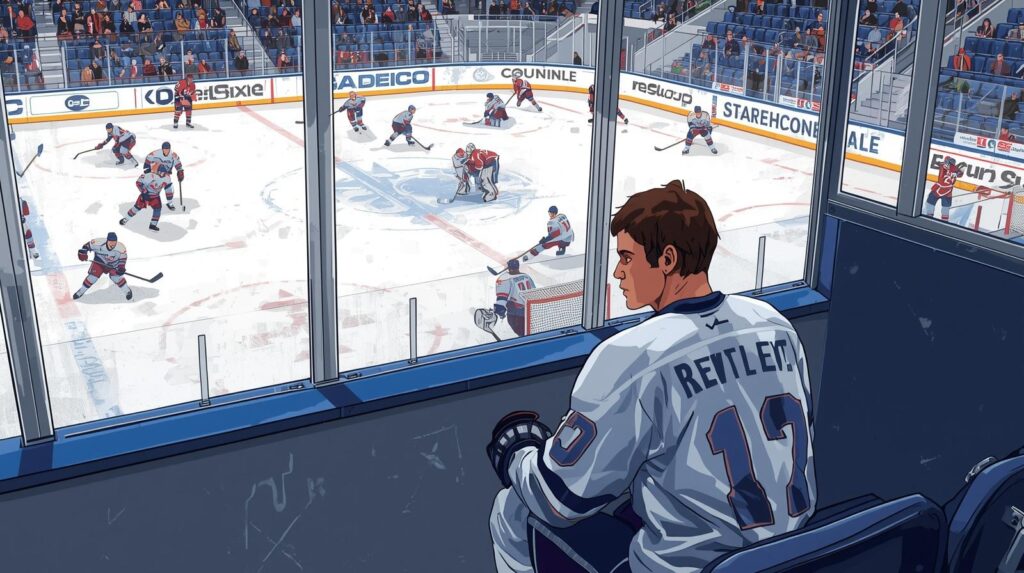
A penalty box (“sin bin”) is where a player serves a time penalty. In hockey, it’s one of the sport’s balancing mechanisms: after an infraction, a team either plays shorthanded for a while, or temporarily loses a specific player without necessarily losing on-ice numbers (in disciplinary cases). The overall logic is similar across rule systems, but the details depend on the governing code: international tournaments use IIHF rules, in the U.S. the baseline national code is USA Hockey, in Canada it more often follows Hockey Canada, and professional leagues (including the NHL) have their own rulebooks and procedures.
Table of Contents
- What Is the Penalty Box and How It Works in Hockey Arenas
- When a Penalty Creates a Power Play—and When It Doesn’t
- Delayed Penalty: When Play Stops and When It Continues
- Hockey Penalty Types and How Long They Last
- Game Misconduct and Match Penalty: Ejection Rules
- Power Play, 5-on-3, and the “No Fewer Than Three Skaters” Rule
- Coincidental Penalties: How Matching Penalties Affect Manpower and Returns
- When Players Are Released From the Penalty Box
- How Power-Play Goals Affect Penalty Time
- Early Release and Illegal Return to the Ice
- Can a Goal Be Disallowed for Too Many Men or an Illegal Release?
- Leaving the Bench During a Fight or Scrum
- Penalty Timekeeper: Who Tracks Penalty Time
- IIHF vs. NHL and North American Rules: Common Differences
- FAQ
What Is the Penalty Box and How It Works in Hockey Arenas
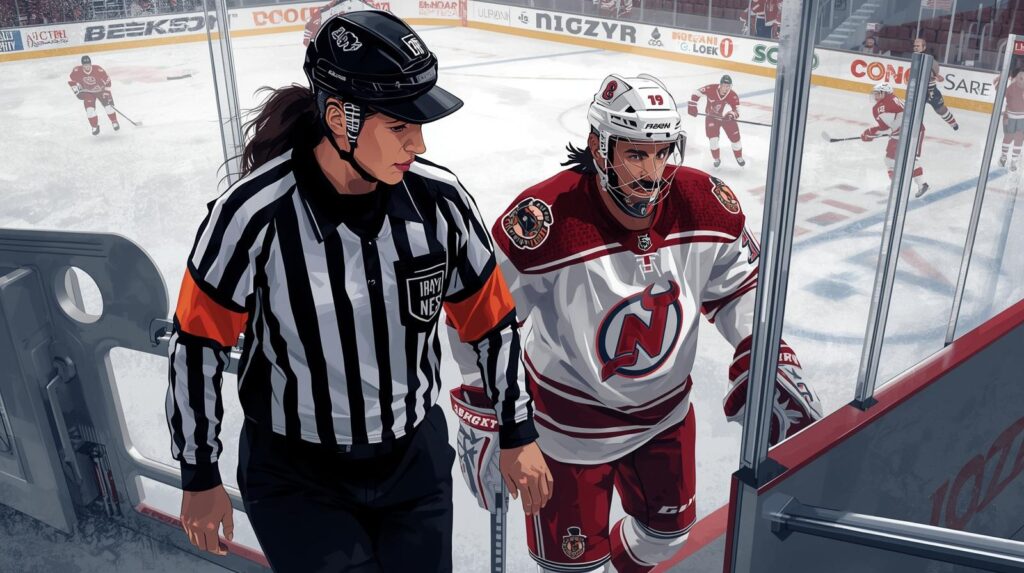
The penalty box is almost always located next to the scorer’s bench, where the game sheet and the clock are managed. Its position relative to the team benches depends on the arena: in some buildings the penalty boxes are on the opposite side, in others on the same side, or in a mixed configuration. A common setup has separate compartments for each team and seating designed for multiple players, but the internal layout can vary (extra sections, separate spots for officials, etc.). Inside the penalty box you’ll find penalized players and the staff assigned to it (a penalty box attendant, sometimes called a penalty box timekeeper; in some arenas, additional arena personnel or security). The idea is simple: access is controlled, and returning to the ice follows a defined procedure.
When a Penalty Creates a Power Play—and When It Doesn’t
Not every penalty automatically turns into a power play. In most rule sets, “game” penalties (minor, major) remove a player from the ice with no replacement and create a manpower advantage for the opponent. Disciplinary sanctions such as a misconduct typically remove the specific player for a set time, but the team is allowed to put a substitute on the ice immediately—so there is usually no numerical disadvantage from that penalty. A common combination is a disciplinary penalty added on top of a game penalty: in that case the shorthanded situation is created by the minor/major, while the misconduct adds extra time that the offending player is unavailable in the rotation.
Delayed Penalty: When Play Stops and When It Continues
The delayed penalty concept exists in both IIHF and North American systems. If the team that committed the infraction does not control the puck, the referee signals the penalty but play continues until the offending side gains possession/control. That way the non-offending team doesn’t lose a potential attacking sequence. If the offending team already has possession and control, play is usually stopped right away. At higher levels this often becomes a tactical moment: the team with the delayed penalty in its favor will pull the goalie for an extra skater to play with a manpower advantage even before the whistle.
Hockey Penalty Types and How Long They Last
Terminology and durations largely overlap across systems, but the formal names and how sanctions can be combined are best confirmed in the rules of the specific league. The logic below generally matches how this is described in IIHF and North American hockey materials.
Minor Penalty (2 Minutes)
A two-minute penalty during which the team plays shorthanded: no substitute is allowed onto the ice. In many rulebooks, a minor that actually creates an opponent’s manpower advantage (i.e., a non-coincidental, non-offsetting penalty) can end early if the power-play team scores a goal. This does not apply to situations where there is no power play on the ice (for example, with coincidental penalties where teams remain at even strength).
Double Minor (4 Minutes)
Four minutes served as two consecutive minors. A typical international example is high-sticking with a visible injury (criteria can vary by league). A power-play goal usually ends only the current two-minute segment: if a goal is scored in the first half, two minutes remain; if it’s scored in the second, the penalty ends.
Major Penalty (5 Minutes)
Five minutes shorthanded. Under IIHF rules and in North American rules (including NHL/USA Hockey), a major is typically served in full and does not end because of opponent goals.
Misconduct Penalty (Usually 10 Minutes)
A 10-minute disciplinary penalty. The team is usually allowed to replace the player immediately, so the shorthanded situation arises only from the “game” part of the punishment (minor/major) if it is assessed along with the misconduct. On scoreboards in these cases you often see two components: the penalty that affects manpower, and the disciplinary one that affects the availability of a specific player.
Game Misconduct and Match Penalty: Ejection Rules
The terms look similar across systems, but they don’t work the same way. Under IIHF rules, a match penalty is an ejection for the rest of the game, usually with an automatic five-minute team penalty served by another player (and it does not end with a goal). In the NHL, a game misconduct is also an ejection for the rest of the game, but it often comes paired with a major (“major + game misconduct”), and the NHL has a separate match penalty category with its own procedure. For the viewer, the key consequence is the same: the player does not return, and the team serves whatever “team” shorthanded time is attached to that specific category of penalty.
Power Play, 5-on-3, and the “No Fewer Than Three Skaters” Rule
A power play happens when one team has fewer skaters because of a non-coincidental penalty. That’s where the classic 5-on-4 and 5-on-3 situations come from. With multiple penalties, a restriction found in most hockey codes applies: a team must not be reduced to fewer than three skaters on the ice. If an additional penalty would, in theory, drop the team below that minimum, its timing starts later—after an earlier penalty expires.
Coincidental Penalties: How Matching Penalties Affect Manpower and Returns
Coincidental penalties are when both teams receive penalties at the same time of the same level (for example, matching minors after a scrum). Teams then typically remain at even strength: substitutes go onto the ice right away, and no power play is created unless additional penalties make the durations unequal. A procedural point common in many rulebooks (including the NHL and often IIHF): players serving coincidental penalties typically do not return “on the fly,” but at the first stoppage of play after the time expires. This reduces the risk of confusion on line changes and an accidental extra player.
When Players Are Released From the Penalty Box
If the penalty created a shorthanded situation (a typical minor/major), in many rulebooks the player may return to the ice immediately when the time expires—even if play is ongoing. That’s why a box exit sometimes becomes an attacking moment on its own: a fresh player appears that the defense doesn’t have time to pick up through a normal change. For coincidental penalties, most systems tie the return to a stoppage: the time may expire during play, but the player comes out at the next whistle. If a penalty hasn’t ended by the horn, the remaining time carries over to the next period and the team starts that period in the corresponding on-ice situation.
How Power-Play Goals Affect Penalty Time
When the team on the power play scores, one active minor that created that advantage is terminated. The order depends on which penalties actually create the manpower difference and how they are queued on the clock. In a 5-on-3, a goal typically returns the situation to 5-on-4, but it does not make the teams even immediately.
Early Release and Illegal Return to the Ice
The logic of leaving early is illustrated well in the USA Hockey Casebook (Rule 629): a penalized player must not leave the penalty bench before the time expires (or before the end of the period). If the player leaves early on their own initiative, an additional minor is typically assessed, and the remaining time of the original penalty still must be served. If the early release happened because of an error by the penalty timekeeper, additional sanctions may not be applied, but the player still must serve the remaining time. In real practice there are organizational situations where, on instruction from officials, the record is corrected or a player is told to move; that is not the same as returning to play. Participation on the ice outside the authorized procedure is considered illegal.
Can a Goal Be Disallowed for Too Many Men or an Illegal Release?
It depends on the rulebook. In some codes, a goal may be waved off if a team was effectively playing with an extra player due to its own fault (too many men, or a player leaving the box early and actually creating an advantage). Reviews typically consider the source of the error (team or officials) and whether the violation affected the scoring play. The most careful phrasing here is: “in certain rulebooks, under specific conditions, a goal can be disallowed.”
Leaving the Bench During a Fight or Scrum
One of the strictest categories in North American rules is leaving the bench (players’ bench or penalty bench) during a scrum/fight or with the intent to intervene. In USA Hockey versions, this typically results in a major and an ejection (often as “major + game misconduct”), with those sanctions assessed in addition to other penalties in the incident. Exact wording and exceptions depend on the competition level, but the idea is the same: prevent an incident from escalating into a line brawl.
Penalty Timekeeper: Who Tracks Penalty Time
A box release is not only a referee’s signal—it’s also an off-ice job. The penalty timekeeper records penalties, runs the countdown, and releases the player when time expires, and in abnormal situations (for example, an early exit) informs the referee and notes the time. The procedures for restoring on-ice strength and deciding when to stop play can differ between leagues, but the principle is shared: officials need the information to apply sanctions correctly.
IIHF vs. NHL and North American Rules: Common Differences
The “skeleton” of the system is largely shared: delayed penalties, minor/major tiers, the power-play concept, and the “no fewer than three skaters” rule exist in many rule sets, including IIHF and NHL/USA Hockey. Differences more often appear in procedural and terminology details: how ejections are administered, what counts as coincidental, how coincidental returns are handled, which infractions automatically trigger harsher sanctions. In IIHF tournaments it’s useful to remember that even familiar terms can have a different procedural “seam” than in the league you watch all season.
FAQ
Can you leave the penalty box without a stoppage?
For penalties that create shorthanded play, many rulebooks allow an “on-the-fly” return as soon as the time expires. For coincidental penalties, the return is often handled at a stoppage of play.
Why are players sometimes released before two minutes are up?
Usually because the power-play team scored during the minor that created the manpower advantage. With a double minor, a goal ends only the current two-minute segment.
Why doesn’t a major end with a goal?
A major reflects a more serious infraction and is usually served in full regardless of opponent goals.
What happens if a player leaves the box early?
In many systems, an additional minor is assessed, and the remaining time of the original penalty still must be served. If the early release was caused by an officials’ error, procedures and additional sanctions can differ—this depends on the competition’s rules.
Can a goal be disallowed because of an illegal release from the box?
In some leagues and rule sets, this is possible under certain conditions, most often when a team effectively gained an advantage from an extra player due to its own fault. If the cause was an officials’ error, decisions are more often tied to the league’s specific procedure.