Hockey Rink Layout Made Simple
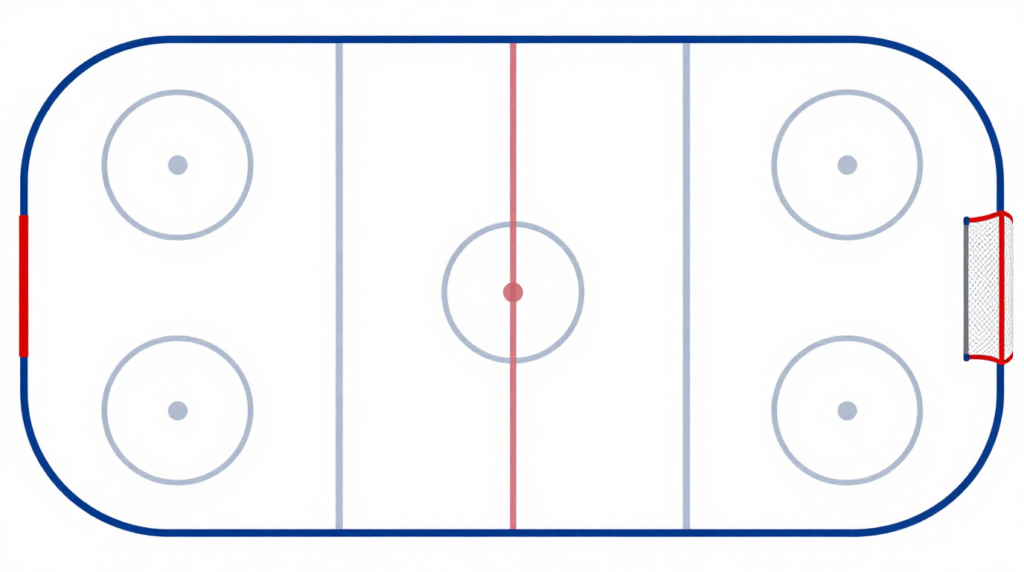
Table of Contents
- What Is an Ice Hockey Rink Layout
- General Shape and Orientation of the Rink
- Standard Ice Hockey Rink Dimensions
- Differences Between NHL Rinks and International Arenas
- Lines on an Ice Hockey Rink
- Ice Hockey Rink Zones
- Boards, Glass, and Safety Elements
- Variations in Non-Professional Rink Layouts
- Why Ice Hockey Rink Layout Matters
What Is an Ice Hockey Rink Layout
An ice hockey rink layout is a system of geometry and markings that defines the framework of the game. Lines, zones, and dots on the ice are not decorative elements: they determine where a team enters the zone, where play resumes after a stoppage, and which areas teams most often defend or attack. The rink is part of the rules, not just a “setting” for the action.
General Shape and Orientation of the Rink
An ice hockey rink is rectangular with rounded corners. The curves help maintain movement along the boards: the puck does not “die” in the corners as often, and plays continue through rebounds and retrievals. The markings are symmetrical around the center line, and there are no true “sides” — teams change ends, while the geometry of the ice remains the same for both.
Standard Ice Hockey Rink Dimensions
There are two widely used standards: North American and international. In North America, the most common format is approximately 200 feet long and 85 feet wide, and at many amateur or school-level arenas the dimensions may vary as long as the overall logic of the markings is preserved. The IIHF international standard typically sets the length at around 60 meters, while the width can vary roughly between 26 and 30 meters. It is the width that most often has the strongest influence on how the game is played.
Differences Between NHL Rinks and International Arenas
The main difference lies in the width of the ice. A narrower rink reduces space, speeds up decision-making, and makes board battles more frequent and more compact. A wider rink offers more room for skating, diagonal passes, and positional play, and mistakes in angle or distance selection tend to be more visible. At the same time, the core elements of the markings — the center line, blue lines, zones, and faceoff dots — are largely similar, though certain details may differ depending on the league and regulations. The most well-known example of such variation is the goaltender’s trapezoid behind the net, which is not used everywhere.
Lines on an Ice Hockey Rink
Center Line
The red center line divides the rink into two halves and serves as the axis of the entire layout. Its role is not limited to a single interpretation: in different eras and leagues, the center line has figured into various officiating nuances, while in modern hockey it primarily functions as a structural reference point for the rink and for game situations.
Blue Lines
The two blue lines define the boundaries of the neutral zone and determine where the offensive zone begins and ends. They are directly tied to the offside rule and influence how teams enter the zone, hold the puck at the blue line, and escape pressure. In practice, this is one of the key “tactical” lines on the ice: even a small step across it changes the status of a play.
Goal Lines
The goal lines are set at a fixed distance from the end boards, but that distance varies by regulation. Under IIHF rules, the goal line is positioned four meters from the end boards, while North American layouts often use a distance of about 11 feet. These lines matter in several ways at once: they are involved in determining goals, icing calls, and the location of faceoffs after stoppages in the zone.
Ice Hockey Rink Zones
Neutral Zone
The neutral zone lies between the blue lines. This is where possession changes most often, teams regroup, and attacks begin, as well as where many transitional moments occur — takeaways, interceptions, quick turns, and acceleration into open ice. The less time a team spends in the neutral zone without control of the puck, the more likely play is to move toward the opponent’s net.
Offensive and Defensive Zones
On either side of the neutral zone are the two end zones. Which one is offensive and which is defensive depends on which net a team is defending at that moment. These are not abstract labels: it is in these zones that positional structures, pressure along the boards, puck retrievals, and long shifts under sustained pressure most often develop.
Center Ice Area
Center Faceoff Dot
The center faceoff dot is located at the geometric center of the rink. It is used for the opening faceoff at the start of the game and each period, as well as after goals are scored. It is the rink’s primary reference point, from which the entire layout is visually read.
Center Circle
The center circle establishes the required distance between players during a faceoff. It makes the start of play controlled: teams have a clear boundary for positioning before the puck is dropped, reducing chaos in the opening seconds of a sequence.
Faceoff Dots and Circles
There are nine faceoff dots on the rink. They are placed so that officials can resume play close to the location of the stoppage, preserving the logical fairness of the situation. In the end zones, the dots are surrounded by full faceoff circles and hash marks used for player positioning. In the neutral zone, the emphasis is on the dots and markings that help regulate player placement during restarts.
Goal Crease and Goal Area
In front of each net is the goal crease. Its purpose is not that skaters are simply “not allowed” to enter it, but that it defines boundaries where contact with the goaltender and interference become especially sensitive. In real games, most controversial situations involving the crease are about interference and interpretation, not about the mere presence of a player in the blue paint.
Crease Markings and Restricted Areas
The crease is highlighted by color and shape so it can be easily read at speed and from a distance. In addition, some arenas and rule sets include specific restricted areas for officials and personnel, such as the referee’s crease near the scorer’s table. The presence and exact shape of these elements depend on the level of competition and the requirements of the organizing body.
Markings Behind the Goal Line
Behind the net, some rinks feature the goaltender’s trapezoid. It limits the area in which the goalie may play the puck with the stick behind the goal line, affecting how a team starts its breakout and how the opponent structures its forecheck. The trapezoid is a clear example of how the basic logic of rink markings remains similar, while individual elements can differ from league to league.
Boards, Glass, and Safety Elements
The ice surface is surrounded by boards that keep the puck in play and make rebounds part of the tactics. Typical board height in professional and near-professional hockey is around 40–48 inches, with protective glass installed above them to separate the rink from spectators. Behind the nets, additional netting is often used, as this is where pucks most frequently travel after deflections and high shots. These elements directly influence tempo: the more play is concentrated along the boards, the more rebounds, retrievals, and puck battles in tight space become decisive.
Variations in Non-Professional Rink Layouts
At practice rinks and public skating facilities, dimensions and proportions often differ from professional standards due to building and infrastructure constraints. Even so, the basic markings are usually preserved: the center line, blue lines, zones, faceoff dots, and goal crease. Where dimensions are smaller, the game naturally becomes more compact, which is noticeable even under the same rules.
Why Ice Hockey Rink Layout Matters
The layout changes playing style without altering team rosters or rules. On narrow ice, density is higher, there is less time to handle the puck, and short board-side sequences more often decide outcomes. On wide ice, spatial awareness becomes more valuable: exit angles, defensive spacing, and the quality of positional pressure. Markings make the game structured and readable, while leaving enough freedom for hockey to remain dynamic and unpredictable.