The Complete NHL Playoff Format: Bracket, Seeding

Hockey playoffs aren’t just “win or go home.” They’re a set of choices a league makes in advance: how many teams qualify, how they’re seeded, whether the bracket is fixed, how long each matchup lasts, how home ice is awarded, and what overtime looks like when there’s no next game to save energy for. Those choices are similar across many competitions, but the details vary by league and by season—especially outside the NHL.
How the Stanley Cup Playoffs Work (NHL Format)
How Many Teams Make the NHL Playoffs
The Stanley Cup Playoffs feature 16 teams, split evenly between the two conferences. In a standard NHL season each club plays 82 regular-season games, and the standings determine who qualifies, who plays whom, and who gets home-ice advantage in each series.
NHL Playoff Qualification: Top Three per Division Plus Wild Cards
The NHL is organized into two conferences and four divisions (two divisions per conference). The first 12 playoff spots go to the top three teams in each division by regular-season points. The remaining four spots go to wild cards: the next two highest point totals in each conference among teams that did not finish in the top three of their division. Because wild cards are chosen at the conference level, it’s possible for one division to send five teams to the postseason while the other sends three.
First-Round Matchups and the NHL Fixed Bracket
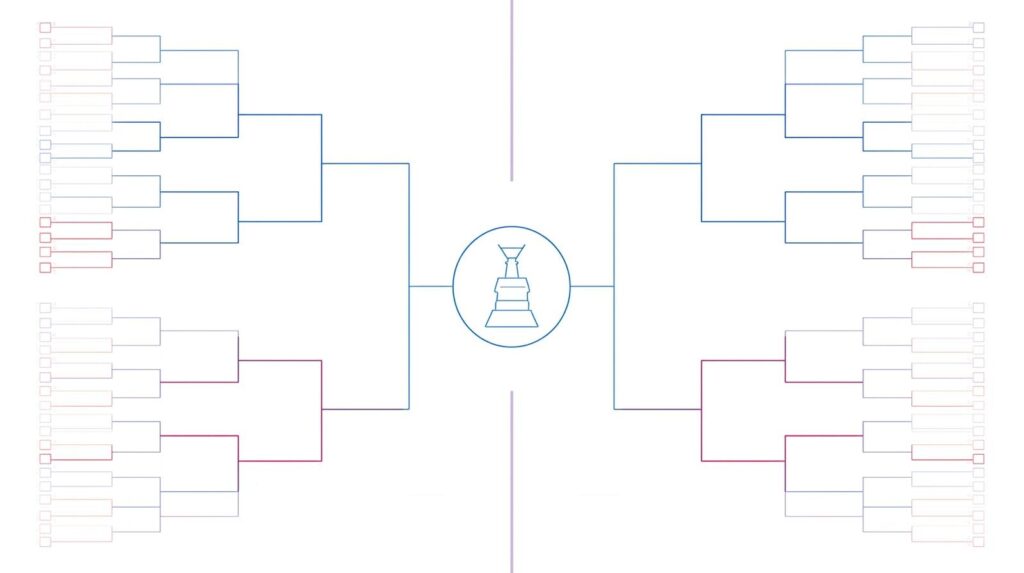
The NHL uses a fixed, largely division-based bracket. In each conference, the division winner with the most points (with official tiebreakers applied if needed) plays the wild-card team with fewer points. The other division winner plays the wild card with the higher point total. Within each division, the teams that finished second and third meet in the other first-round series.
From there, teams advance along the bracket rather than being re-seeded after each round. First-round winners move to the second round, second-round winners reach the Conference Finals, and the conference champions meet in the Stanley Cup Final.
NHL Playoff Rounds and Series Length
The NHL has four rounds: First Round, Second Round, Conference Finals, and the Stanley Cup Final. Every round is played as a best-of-seven series—the first team to win four games advances.
Best-of-Seven Series, Scheduling, and the 2–2–1–1–1 Home-Ice Format
Why the NHL Uses Best-of-Seven
A best-of-seven series rewards the team that can solve a matchup over time. Coaching adjustments, special-teams execution, goaltending management, and depth tend to matter more as the series goes on, which is part of why the NHL sticks with this format through all four rounds.
How Home Games Are Split in a Series (2–2–1–1–1)
NHL playoff series are typically played in a 2–2–1–1–1 pattern. The team with home-ice advantage hosts Games 1, 2, 5, and 7, while the other team hosts Games 3, 4, and 6. Exact dates can shift due to arena availability and broadcast scheduling, but the home/away distribution follows that structure.
How Home-Ice Advantage Is Determined in the NHL Playoffs
In every playoff series, home-ice advantage goes to the team with the better regular-season record relative to its opponent—based on points and the NHL’s official tiebreakers. This applies throughout the postseason. What changes from round to round isn’t the home-ice rule; it’s simply that the NHL’s bracket determines who you face, especially early, because the matchups are set by the division-based structure.
NHL Tiebreakers: What Happens When Teams Finish Level on Points
The NHL does not break standings ties with an extra “playoff game.” Positions are decided using the league’s tiebreak procedure. The exact ordering and wording of those criteria can be updated over time, and edge cases (like uneven games played) can matter in unusual seasons. The practical takeaway is that the league looks beyond raw points to separate teams using a defined sequence that emphasizes regulation/OT outcomes (not shootouts), head-to-head results, and season-long goal metrics.
Playoff Overtime in the NHL: No Shootouts, Sudden Death, Full Periods
Overtime is one of the cleanest rule differences between the NHL regular season and the Stanley Cup Playoffs. Regular-season games can be decided by a short 3-on-3 overtime and then a shootout. In the playoffs, there are no shootouts. If a game is tied after regulation, teams play 20-minute, 5-on-5 sudden-death overtime periods. If nobody scores, they play another full overtime, and then another, until a goal ends the game.
Key NHL Playoff Terms
Wild card
A playoff team that qualifies in its conference without finishing top three in its division, based on regular-season points.
Bracket (fixed bracket vs re-seeding)
A bracket is the set path through the rounds. The NHL uses a fixed bracket: teams advance along the predetermined route rather than being re-seeded after each round based on remaining seeds.
Home-ice advantage
The right to host four games in a best-of-seven series, including Game 7 if it happens. In the NHL it’s awarded by comparing regular-season records between the two teams in a given matchup.
RW and ROW
Common standings shorthand in North American hockey. RW refers to regulation wins. ROW refers to regulation plus overtime wins (excluding shootout wins). How prominently these appear in standings discussions depends on the league and the season’s published tiebreak order.
Calder Cup Playoffs (AHL): Why the Format Is Harder to Summarize in One Sentence
The AHL’s postseason is more flexible than the NHL’s. The league’s structure includes more divisions than the NHL in its modern alignment, and the playoff field size and round design have changed over different periods. That’s why any claim that the AHL “always” uses a single number of qualifiers or a single fixed series-length ladder is easy to get wrong without a season attached.
What Shapes the AHL Playoff Format
AHL divisions can differ in size, and the league has to balance travel, arena availability, and a compressed calendar while still producing a champion. As a result, the AHL has used mechanisms the NHL doesn’t rely on, such as byes for certain teams, play-in rounds, and shorter series early in the bracket in some seasons.
AHL Playoff Series Length
The common pattern in many AHL formats is that earlier rounds may be shorter than best-of-seven, while later rounds move toward longer series. The precise breakdown—how many teams qualify, whether there are byes, and which rounds are best-of-3, best-of-5, or best-of-7—should be treated as season-specific rather than universal.
NHL vs AHL Playoff Formats: Practical Differences
The NHL offers a stable postseason: 16 teams, four rounds, best-of-seven all the way, and a fixed, division-driven bracket. The AHL is more variable by design, often adapting its playoff structure to the league’s current alignment and scheduling realities. Both formats aim for the same endpoint—a champion—but they prioritize different constraints along the way.
Why the NHL Playoff Format Gets Debated
Most arguments aren’t about best-of-seven. They’re about the bracket. Because the NHL’s early rounds are division-based and fixed, strong teams can meet earlier than they would in a pure 1–8 conference seeding. Supporters of the current approach point to consistent rivalries and reduced travel in the opening rounds; critics focus on how much—or how little—the system rewards regular-season dominance outside the very top seeds.
How the NHL Playoff Format Has Changed Over Time
The Stanley Cup Playoffs have been rebuilt more than once as the league expanded and realigned. The current division-heavy bracket has been in place since the 2013–14 season. The league also used modified formats in 2020 and 2021 due to pandemic-related disruption before returning to the standard structure.
FAQ: Quick NHL Playoff Questions People Actually Ask
How many teams make the Stanley Cup Playoffs?
Sixteen teams qualify.
How many rounds are in the NHL playoffs?
Four rounds: First Round, Second Round, Conference Finals, and Stanley Cup Final.
Are there shootouts in the NHL playoffs?
No. Playoff overtime is 20-minute, 5-on-5 sudden death, repeated as needed.
How are home games distributed in a best-of-seven NHL series?
Typically 2–2–1–1–1, with the home-ice team hosting Games 1, 2, 5, and 7.
Is the NHL bracket re-seeded after each round?
No. The bracket is fixed.
Does the AHL use the same playoff format as the NHL?
Not consistently. The AHL’s number of qualifiers, the presence of byes or play-in rounds, and series length can vary by season, so it’s best treated as format-by-year rather than a single permanent template.